destroy_all vs delete_all in Rails: Performance, Callbacks, and When to Use Each
destroy_all runs callbacks, one query per record. delete_all = one SQL DELETE, no callbacks. Learn when each is safe and what breaks if you choose wrong.
Paste your SQL and compare it with the SQL Rails generates — before it breaks production.
Free online tool for Ruby developers • Supports JOINs, subqueries, and complex patterns • No registration required
New to ActiveRecord? Check out our comprehensive guide or browse practical examples
Note: Our converter handles most common SQL patterns accurately. For complex queries, please review and test the generated ActiveRecord code in your application.
Common SQL patterns developers translate to ActiveRecord — with notes on where Rails behaves differently.
SQL Query:
Used 64 times
Select * from rails
ActiveRecord:
Rail.all
SQL Query:
Used 63 times
SELECT smart_folders.id, smart_folders.label_name, board_items.id, board_items.description, board_items.date
FRO...
ActiveRecord:
BoardItem.joins(:board, :smart_folder)
.where(smart_folders: { user_id: 11 })
.where(board_items: { date: '2025-1...
SQL Query:
Used 63 times
Select * from rails left join upworks on upworks.rail_id = rails.id group by id
ActiveRecord:
Rail.left_joins(:upworks).group(:id)
SQL Query:
Used 63 times
SELECT * FROM users
LEFT JOIN book b ON b.id = users.id_book
RIGHT JOIN role r ON r.id = users.id_role
INNER J...
ActiveRecord:
User.joins(:car).right_joins(:role).left_joins(:book)
SQL Query:
Used 63 times
SELECT * FROM wallets WHERE type = "CurrencyWallet" AND closed_at IS NULL AND NOT disabled_at IS NULL;
ActiveRecord:
Wallet.where(type: 'CurrencyWallet', closed_at: nil, disabled_at: nil)
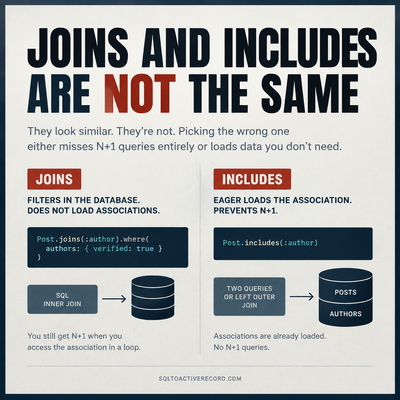
ActiveRecord's joins creates INNER JOINs by default, silently filtering out NULL associations and changing your result set.
Using includes for N+1 prevention can accidentally change query semantics and return unexpected duplicate records.
Adding distinct can hide broken joins that create Cartesian products, making "wrong" queries appear to work correctly.
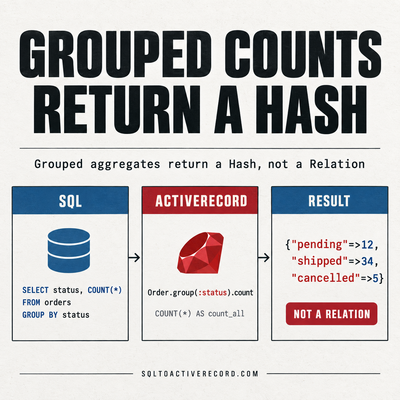
ActiveRecord's group and having methods can return "correct-looking" but semantically wrong counts and aggregations.
Built for PostgreSQL-first Rails apps. MySQL and SQLite are supported for common query patterns:
Advanced features like JSON queries, window functions, and complex joins.
PostgreSQL Guide →Generates Rails ActiveRecord code following proper conventions and best practices.
No setup, no registration, no waiting. Paste SQL and get production-ready ActiveRecord code in seconds.
Every conversion teaches Rails best practices. Perfect for teams learning ActiveRecord patterns.
See how common SQL patterns translate to Rails ActiveRecord syntax:
SELECT * FROM posts WHERE published = true AND created_at > '2024-01-01'
Converts to:
Post.where(published: true).where('created_at > ?', '2024-01-01')
SELECT users.name, posts.title FROM users INNER JOIN posts ON users.id = posts.user_id
Converts to:
User.joins(:posts).select('users.name, posts.title')
SELECT category, COUNT(*) FROM products GROUP BY category
Converts to:
Product.group(:category).count
SELECT * FROM articles ORDER BY created_at DESC LIMIT 10
Converts to:
Article.order(created_at: :desc).limit(10)
Looking for specific SQL patterns? Explore our guides:
Convert SQL queries to ActiveRecord instantly without any setup or registration
Generated code follows Rails conventions and ActiveRecord patterns
Great for learning Rails patterns and migrating from other frameworks
Your queries are processed securely in your browser. We never store or track your SQL code.
SSL encrypted. Your queries are processed in your browser, never stored on our servers.
No tracking, no analytics on your SQL queries. We respect your code privacy.
Your SQL queries are never logged, stored, or transmitted. Everything stays local.
Instant conversions with no server round-trips. Fast and reliable.
"Saved me hours when migrating a legacy Rails app. The ability to see both the ActiveRecord code AND the generated SQL is invaluable."
Sarah Johnson
Senior Rails Developer
"Perfect for learning ActiveRecord. I can paste SQL from tutorials and immediately understand the Rails way of doing things."
Mike Chen
Full Stack Developer
"The verification feature is brilliant. It caught a LEFT JOIN issue that would have been a nightmare to debug in production."
Alex Rivera
Backend Engineer
Deep dives on SQL, ActiveRecord patterns, and Rails performance
destroy_all runs callbacks, one query per record. delete_all = one SQL DELETE, no callbacks. Learn when each is safe and what breaks if you choose wrong.
Learn how ActiveRecord select() cut query time 40% by limiting columns. Real benchmarks: 18.7MB to 2.1MB data transfer, 72% faster object creation on 14K
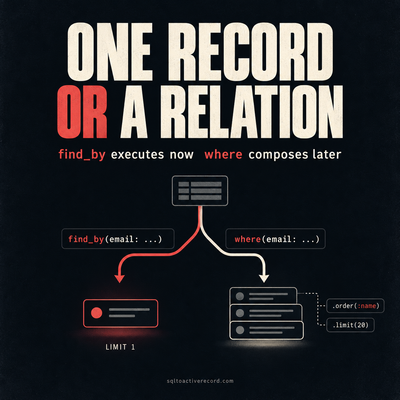
Yes, find_by returns nil when no record is found. Learn find vs find_by, nil handling, and production-safe patterns. Updated April 2026.
We're constantly improving this tool based on user feedback. Found a bug? Have a feature request? Want to share your experience?