ActiveRecord INNER JOIN with Multiple Conditions (Without Lying to Yourself)
Rails INNER JOIN with multiple ON conditions — without moving predicates into WHERE by accident. .merge(), Arel, and SQL verification. Rails 7/8, 2026.
Real solutions to SQL → ActiveRecord translation problems. Learn why your queries break, how to fix them, and what Rails actually generates.
New to ActiveRecord? These posts explain the mental model differences that cause bugs.
LEFT JOINs that become INNER JOINs, multiple conditions, and association gotchas
Rails INNER JOIN with multiple ON conditions — without moving predicates into WHERE by accident. .merge(), Arel, and SQL verification. Rails 7/8, 2026.
Adding WHERE after LEFT JOIN in Rails silently converts it to INNER JOIN. Here's why it happens, how to spot it, and the fix with .merge() or subqueries.
Rails has no native FULL OUTER JOIN. Here are three working approaches: Arel, find_by_sql, and union of LEFT + RIGHT joins. With SQL output for each.
N+1 queries, includes() side effects, and when ActiveRecord makes things slower
Rails 8.2 for production apps: caching, query performance, concurrency changes, and what actually breaks at scale. No hype, just impact. Updated 2026.
N+1 queries aren't a Rails flaw — they come from how you shape associations. Learn to spot the pattern early and fix it without over-eager loading.
Ruby 4.0.0 is out. For Rails developers, here's what actually changes: removed APIs, performance gains, and the breaking changes that hit ActiveRecord.
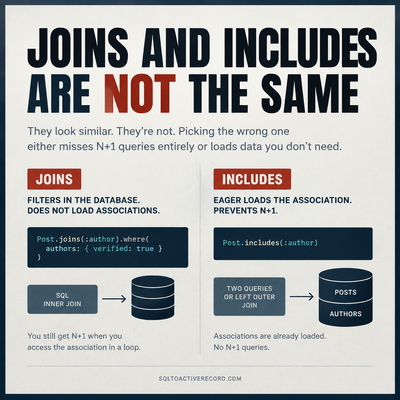
joins filters using SQL JOIN. includes prevents N+1 by eager loading. Using the wrong one creates hidden performance problems. Rails 7/8 with SQL output.
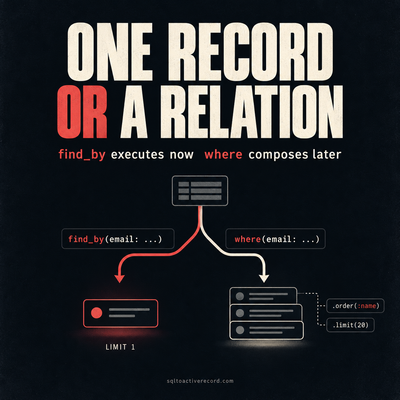
where returns a relation, find_by returns one record or nil. Here's when each is correct, what breaks if you pick wrong, and Rails 7/8 production patterns.
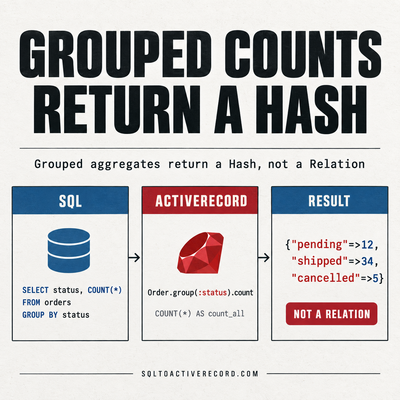
How to use group and count in ActiveRecord for SQL GROUP BY. With having, order, and the SQL Rails generates. Rails 7/8 production examples with output.
destroy_all runs callbacks and triggers dependent destroys. delete_all is a single SQL DELETE. Here's when each is correct and what breaks if you pick wrong.
Added select() to stop loading unused columns. Response times dropped 40%. Here's the pattern, what to watch for with missing attributes, and when worth it.
find_by returns nil when no record matches. find raises RecordNotFound. Nil handling, rescue patterns, and when to use each in Rails production. 2026.
The database had indexes. ActiveRecord queries weren't using them. Here's how ActiveRecord query patterns bypass indexes and how to check EXPLAIN output.
Using each on large ActiveRecord collections loads all records into memory. find_each batches them. Here's why background jobs need this and the gotchas.
A 5-table ActiveRecord join took 8 seconds. Rewriting it as a subquery took it to 200ms. Here's what changed and why the query planner behaves differently.
ActiveRecord was running 47 identical queries per request. Bullet found the pattern. Here's what caused it, how to read Bullet's output, and the fix.
posts.count hit the database on every request and brought down production. Here's how counter cache fixes it, what to watch for, and how to backfill safely.
pluck, select, and map look interchangeable but have very different memory profiles. Here's which one killed our production app and when to use each.
When ActiveRecord's abstraction costs 80% of query performance, raw SQL is the right call. Here's how to know when to drop down and do it safely in Rails.
I added includes() to every association to fix N+1 queries. Performance got worse. Here's why eager loading isn't always the answer and when to use each.
Added includes() to every N+1 warning. Response times went up, not down. Here's what went wrong and how to choose between eager loading and joins.
A SQL to ActiveRecord converter exists. Leaning on it without understanding means you can't debug what it outputs. Here's how the tool teaches as it converts.
Migrating a legacy PHP app to Rails — the biggest challenge wasn't the syntax or frameworks. It was thinking in relationships instead of tables.
A junior dev asked why we use ActiveRecord instead of raw SQL. I gave the textbook answer. They weren't convinced. Then production happened.
I had SQL certification on my resume and failed a Rails interview. Knowing databases and knowing ActiveRecord are two different skills. Here's the gap.
I read Agile Web Development with Rails cover to cover. I still couldn't write production queries. Here's the gap between theory and what actually works.