LEFT JOIN + WHERE in ActiveRecord: The Trap That Turns It Into INNER JOIN
AKeep outer-join semantics by putting predicates in ON, using where.missing/where.associated, or switching to EXISTS

TL;DR: User.left_joins(:memberships).where(memberships: { active: true }) is a LEFT JOIN that behaves like an INNER JOIN. The WHERE on the right-side table excludes NULL rows. Fix: move the condition into the JOIN clause with a string join, or use where.missing / where.associated for presence checks. For more on join, read Rails ActiveRecord Query Interface Guide (2026).
Start from a real production bug
You’re asked for: “Show all users. If they have an active membership, show it. Otherwise still show the user.”
You write what looks like the obvious Rails query:
User.left_joins(:memberships).where(memberships: { active: true })

It passes basic tests.

Then the CSV export goes out… and support notices entire groups of users are missing:
- users without memberships
- users with only inactive memberships
- anyone who should have been included because the UI said "optional"

Nothing "crashed".
You just shipped the wrong dataset.

---
The wrong mental model

"LEFT JOIN means I keep left-side rows even if I filter the right side."

That's only true if your filter is part of the JOIN condition (ON).

If your filter ends up in WHERE, it runs after the join.
Rows with no right-side match have NULLs, and NULLs fail most WHERE predicates.

So you accidentally get INNER JOIN behavior.

---
The trap in Rails: left_joins + where(joined: ...)

The naive ActiveRecord

User
  .left_joins(:memberships)
  .where(memberships: { active: true })

Typical SQL (verify with to_sql):

SELECT "users".*
FROM "users"
LEFT OUTER JOIN "memberships"
  ON "memberships"."user_id" = "users"."id"
WHERE "memberships"."active" = TRUE

This removes rows where memberships.active is NULL (i.e., users with no memberships).
That's the entire bug.

---
Decide intent first (this is where people mess up)

These are different questions:

Intent A — "Only users who have an active membership"

That's INNER JOIN intent. Don't pretend it's a LEFT JOIN:

User.joins(:memberships).where(memberships: { active: true }).distinct

Intent B — "All users, but only join active memberships if present"

That's true LEFT JOIN intent: predicate belongs in ON, not WHERE.

Intent C — "Users with no memberships"

That's an anti-join. Rails has a direct API for it.

If you don't name the intent, you'll keep rewriting queries and getting surprised.

---
Correct approach #1: Put predicates in ON (scoped association)

If your intent is B ("all users, optional active memberships"), use a scoped association so Rails places the predicate in the JOIN:

# app/models/user.rb
class User < ApplicationRecord
  has_many :memberships
  has_many :active_memberships, -> { where(active: true) }, class_name: "Membership"
end

Then:

User.left_joins(:active_memberships)

SQL shape you want:

SELECT "users".*
FROM "users"
LEFT OUTER JOIN "memberships"
  ON "memberships"."user_id" = "users"."id"
 AND "memberships"."active" = TRUE

Now users without memberships still appear. You preserved LEFT JOIN semantics.

Common follow-up: "Only users who have an active membership"

Don't add where(memberships: ...) after the fact. Filter intentionally:

User.left_joins(:active_memberships).where.not(memberships: { id: nil })

(Depending on your association/table name, you may need to qualify the joined table alias—verify SQL.)

---
Correct approach #2: Use where.missing / where.associated

If your intent is C ("no memberships"):

User.where.missing(:memberships)

If your intent is "must have at least one membership":

User.where.associated(:memberships)

These read like intent and are harder to accidentally "fix" into the wrong thing later.

---
Correct approach #3: Use EXISTS to avoid duplicates and scale better

If your real intent is:

"Users where an active membership exists"

EXISTS is often the most production-friendly form:
- no duplicate users
- no .distinct tax
- planner can short-circuit on first match

active_membership_exists =
  Membership
    .where("memberships.user_id = users.id")
    .where(active: true)
    .arel.exists

User.where(active_membership_exists)

Index that supports it well:

CREATE INDEX CONCURRENTLY index_memberships_on_user_id_active
ON memberships (user_id, active);

---
Debugging workflow: verify WHERE vs ON every time

When you translate a LEFT JOIN query, do this:

relation = User.left_joins(:memberships).where(memberships: { active: true })
puts relation.to_sql

Then answer:

- Did the predicate land in WHERE? (likely inner-join behavior)
- Or did it land in ON? (true left-join semantics)

If you don't verify, you're guessing.
And guessing with LEFT JOIN is how you ship missing rows.

---
Production pitfalls

1) Duplicates

LEFT JOIN duplicates parent rows when multiple children match.
If you only need "users", choose EXISTS or .distinct intentionally.

2) Eager loading vs join filtering

left_joins is for filtering. It does not preload association objects.
You can still hit N+1 in the view. Use preload/includes separately if you render associations.

3) Default scopes leak in

If Membership has default_scope (soft deletes, tenancy), scoped associations and merges can import that behavior.
That might be correct—but you should know it's happening.

4) NULL semantics are the whole point

LEFT JOIN produces NULLs for missing right rows.
Any WHERE predicate on right columns must handle NULLs deliberately, or you've lost the outer join.

---
Rule of thumb

If you write left_joins(...).where(joined_table: ...), assume you just built INNER JOIN behavior.

Choose by intent:

- Must match: joins / where.associated
- Optional join but filtered right rows: put predicates in ON (scoped association)
- Missing association: where.missing
- Scale + no duplicates: EXISTS To understand activerecord fundamentals, see [ActiveRecord INNER JOIN with Multiple Conditions (Without Lying to Yourself)](/blog/activerecord-inner-join-with-multiple-conditions-without-lying-to-yourself).Was this article helpful?
Your feedback helps us improve our content
How We Verify Conversions
Every conversion shown on this site follows a strict verification process to ensure correctness:
- Compare results on same dataset — We run both SQL and ActiveRecord against identical test data and verify results match
-
Check generated SQL with
to_sql— We inspect the actual SQL Rails generates to catch semantic differences (INNER vs LEFT JOIN, WHERE vs ON, etc.) - Add regression tests for tricky cases — Edge cases like NOT EXISTS, anti-joins, and predicate placement are tested with multiple scenarios
- Tested on Rails 8.1.1 — All conversions verified on current Rails version to ensure compatibility
Last updated: October 14, 2026
Try These Queries in Our Converter
See the SQL examples from this article converted to ActiveRecord—and compare the SQL Rails actually generates.
Deep Dive into ActiveRecord
Raza Hussain
Full-stack developer specializing in Ruby on Rails, React, and modern JavaScript. 15+ years upgrading and maintaining production Rails apps. Led Rails 4/5 → 7 upgrades with 40% performance gains, migrated apps from Heroku to Render cutting costs by 35%, and built systems for StatusGator, CryptoZombies, and others. Available for Rails upgrades, performance work, and cloud migrations.
More on Aggregations & Grouping
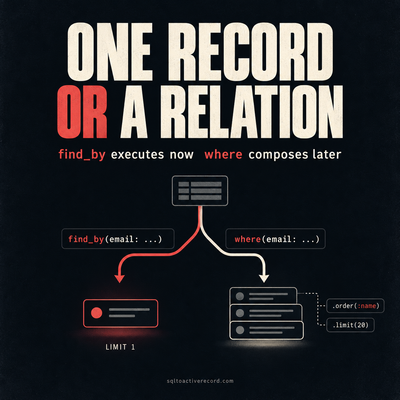
ActiveRecord where vs find_by — Which to Use When
where returns a relation, find_by returns one record or nil. Here's when each is correct, what breaks if you pick wrong, and Rails 7/8 production patterns.
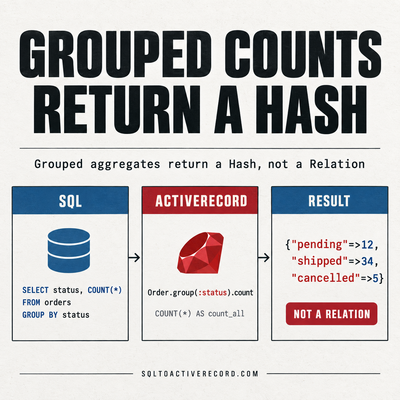
ActiveRecord group and count — SQL GROUP BY in Rails
How to use group and count in ActiveRecord for SQL GROUP BY. With having, order, and the SQL Rails generates. Rails 7/8 production examples with output.

Added select() to Limit Columns. Performance Improved 40%. Stopped Loading Data I Didn't Need.
Added select() to stop loading unused columns. Response times dropped 40%. Here's the pattern, what to watch for with missing attributes, and when worth it.
Leave a Response
Responses (0)
No responses yet
Be the first to share your thoughts