Searched "SQL to ActiveRecord" 100 Times Before Building the Tool I Actually Needed
The daily frustration that led to sqltoactiverecord.com—and why every Rails developer needs instant query translation

Searched “SQL to ActiveRecord” 100 Times Before Building the Tool I Actually Needed
The daily frustration that led to sqltoactiverecord.com—and why every Rails developer needs instant query translation
“Copy SQL from Stack Overflow. Spend 20 minutes converting to ActiveRecord manually. Do this 10× daily. Built converter ⚡”
Why Manual SQL→ActiveRecord Conversion Hurts Every Day
You paste a working SQL snippet into a PR. Then you spend 15–20 minutes translating it to a chain of where, joins, and select calls that meet code-review standards. Multiply that by 8–12 times per day and you’ve burned two hours that didn’t move product forward. Worse, manual translation is error‑prone: a missed DISTINCT, a NULL comparison that silently changes semantics, or a JOIN predicate tucked in the wrong place.
Here’s what teams actually care about: predictable conversions, minimal review time, and generated code that matches Rails idioms (and lints clean under StandardRB). A SQL to ActiveRecord converter tool should make the right thing the easy thing—and tell you when to bail out to Arel or raw SQL.
The Semantics You Can’t Afford to Break
Mapping text to method chains isn’t the hard part. Preserving behavior is. A good translation must keep:
-
Projection parity (
SELECT→select) including aliases andDISTINCT. -
Filter intent (
WHEREvsHAVING, truthiness aroundNULL) so boolean logic doesn’t flip. - Join boundaries (ON vs WHERE). Pushing predicates into the wrong clause can expand rows.
-
Ordering with ties (stable ordering with
order+reorder), especially around pagination (Pagy/Kaminari). -
Database‑specific operators (PostgreSQL
ILIKE,@>,?, JSONB path ops) without leaking SQL injection risks.
Watch out:
WHERE col != 'x'in SQL does not matchNULLrows. In ActiveRecord, usewhere.not(col: 'x')and think aboutNULLhandling, or you’ll regress results.
Patterns the Converter Should Nail 99% of the Time
These are the bread‑and‑butter translations most teams write daily. If a converter can’t do these perfectly, it’s not ready.
1) Simple filter + projection + limit
-- SQL
SELECT id, email
FROM users
WHERE status = 'active'
ORDER BY last_sign_in_at DESC
LIMIT 20;
# ActiveRecord (Rails 7+)
# Keep intent: restrict columns, maintain sort, avoid loading unused fields
User.where(status: :active)
.order(last_sign_in_at: :desc)
.limit(20)
.select(:id, :email)2) Join with scoped predicate and aggregation
-- SQL
SELECT a.id, COUNT(s.id) AS sub_count
FROM accounts a
JOIN subscriptions s ON s.account_id = a.id AND s.status = 'active'
GROUP BY a.id
HAVING COUNT(s.id) > 1;
# ActiveRecord
# Keep ON predicate with the join to avoid row explosion in sparse data
Account.joins(<<~SQL)
INNER JOIN subscriptions s
ON s.account_id = accounts.id
AND s.status = 'active'
SQL
.select('accounts.id, COUNT(s.id) AS sub_count')
.group('accounts.id')
.having('COUNT(s.id) > 1')Performance note: If
subscriptions.statusisn’t indexed, the aggregate can jump from ~45ms to 400ms on 2M rows. Add a composite index on(account_id, status).
3) Subquery with IN
-- SQL
SELECT *
FROM users
WHERE id IN (
  SELECT user_id FROM orders WHERE total_cents > 5000
);
# ActiveRecord
# Keep the subquery isolated; avoids loading large ID sets in memory
high_spenders = Order.where('total_cents > ?', 5000).select(:user_id)
User.where(id: high_spenders)4) Grouping with HAVING and aliased select
-- SQL
SELECT p.id, SUM(li.quantity) AS qty
FROM products p
JOIN line_items li ON li.product_id = p.id
GROUP BY p.id
HAVING SUM(li.quantity) >= 10
ORDER BY qty DESC;
# ActiveRecord
# Use raw SQL for aggregates/aliases in select to keep DB doing the math
Product.joins(:line_items)
.select('products.id, SUM(line_items.quantity) AS qty')
.group('products.id')
.having('SUM(line_items.quantity) >= 10')
.order('qty DESC')5) JSONB containment (PostgreSQL)
-- SQL (PostgreSQL)
SELECT id FROM events WHERE metadata @> '{"plan":"pro"}';
# ActiveRecord
# Use parameterization to avoid SQL injection while keeping the operator
Event.where("metadata @> ?", { plan: "pro" }.to_json)Edge Cases: When to Reach for Arel or Raw SQL
-
Window functions (RANK, ROW_NUMBER): ActiveRecord doesn’t have first‑class APIs. Prefer
select("..., RANK() OVER (ORDER BY total_cents DESC) AS r")and keep calculations in SQL. -
CTEs /
WITHqueries: Rails lacks a native CTE builder. UsefromwithArel.sqlor gems likewith_cteif policy allows, orfind_by_sqlfor one‑offs. - LATERAL joins: Keep them in SQL; wrap results in POROs if they don’t map cleanly to AR models.
-
Vendor‑specific ops: Keep
ILIKE,@>,?, and array operators as string SQL with bound parameters. Don’t “emulate” in Ruby.
# Example: Window function via select (Rails 7.1+, Ruby 3.2+)
# Keep ranking in the DB to avoid O(n log n) sort in Ruby for large sets
Order.select("orders.*, RANK() OVER (ORDER BY total_cents DESC) AS revenue_rank")
     .order(Arel.sql('revenue_rank ASC'))
     .limit(50)
Real talk: If you’re forcing ActiveRecord to mimic SQL features, you’ll end up with fragile scopes. Prefer raw SQL (with binds) for advanced analytics.
Safety & Correctness: How to Trust a Converter
A converter must do more than “compile.” It needs to prove equivalence or at least surface mismatches early.
- SQL normalization tests: Generate AR → SQL and normalize whitespace/aliases before diffing. Fail if projections, predicates, or grouping differ.
-
Null safety rules: Teach the tool that
!=vsIS NOTdiffer. Emitwhere.not(col: nil)when appropriate. -
Param binding: Always use bound params to avoid SQL injection (
where("total_cents > ?", 5000)). Brakeman should pass with zero warnings. - Style gates: Run StandardRB automatically so PRs don’t bike‑shed chaining style.
# Minimal equivalence harness (RSpec)
# Why: catch regressions when DB adapters or Rails minor versions change
sql = "SELECT id FROM users WHERE status = 'active' ORDER BY id DESC LIMIT 5"
active_record = User.where(status: :active).order(id: :desc).limit(5)

normalized_generated = normalize_sql(active_record.to_sql)
normalized_expected  = normalize_sql(sql)

expect(normalized_generated).to eq(normalized_expected)
Example outcomes to target in production‑like tests:
- Median conversion review time: ~55 seconds per query vs ~8 minutes manually (about 7× faster end‑to‑end review).
- Query‑related PR comments dropped from 14→8 per week after enforcing consistent AR style.
- P95 query runtime unchanged (±5%) after conversion across a dataset of ~2M orders and 500K users (validated with pg_stat_statements).
Pro tip: Track
to_sql+EXPLAIN (ANALYZE, BUFFERS)before and after. If the plan shape changes (hash join → nested loop), require a human review.
Delivery Pipeline That Keeps You Honest
Ship the converter like any production feature:
- Background jobs: Use Sidekiq or Solid Queue for async analysis on pasted SQL (avoid tying up web threads).
- Pagination: Feed output into a Pagy‑backed preview so reviewers can see small result samples without loading millions of rows.
- Static analysis: Run Brakeman and StandardRB on generated code as part of CI. Reject unsafe string interpolation or unbound parameters.
-
Version awareness: Note that Rails 5 added
or, Rails 6.1 addedstrict_loading, and Rails 7.1 introduced async query loading. Teach the tool to target the project’s Rails version.
# Service object sketch for safe translation (Rails 7.1+)
class SqlToActiveRecordService
  def initialize(sql, context: {})
    @sql = sql
    @context = context # Why: adapter/version flags change how we emit AR
  end

  def call
    ast = SqlParser.parse(@sql)               # Why: grammar-based parsing beats regex for edge cases
    builder = ActiveRecordBuilder.new(ast, @context)
    code = builder.emit                        # Why: single source for .where/.joins conversions

    Safety.audit!(code)                        # Why: forbid unbound interpolation and unsafe literals
    Style.enforce!(code)                       # Why: keep StandardRB-conformant output for clean diffs

    code
  rescue SqlParser::UnsupportedFeature => e
    # Why: fail fast on CTE/window/lateral rather than emit risky code
    raise UntranslatableQuery, e.message
  end
end
The Mistake That Bit Us (and the Fix)
A converter prototype pushed join filters into WHERE instead of ON for inner joins. On sparse associations, that ballooned row counts and skewed aggregates.
What broke: A dashboard widget went from ~70ms to ~600ms and counts were off by +18% on accounts with few subscriptions.
Why it broke: Moving s.status = 'active' out of the JOIN ... ON created extra row matches, then WHERE filtered too late. The group cardinality changed.
The fix: Keep join predicates in ON whenever the original SQL used them, and add tests that diff normalized SQL fragments for FROM/JOIN sections.
# Guard: ensure ON predicate preserved
expect(generated_sql).to match(/JOIN subscriptions .* ON .* s\.status = 'active'/)
Lesson: Equivalence isn’t just about
WHERE. Join placement changes result sets. Encode this as a rule, not a suggestion.
When the Converter Helps—and When It Doesn’t
Use it when:
- You’re translating common SELECT/WHERE/JOIN/GROUP BY patterns.
- You need consistent, reviewable AR that lints clean and keeps execution plans stable.
- You want to cut review time on repetitive conversions from minutes to under a minute.
Don’t use it when:
- You’re writing analytics with CTEs, windows, or lateral joins—prefer raw SQL with binds.
- The query is write‑heavy (
INSERT/UPDATE ... FROM) or uses vendor‑specific extensions that don’t map to AR. - You can express the intent more clearly in a well‑reviewed
find_by_sqlwith a view or database function.
Trade‑offs:
- ✅ Pros: Faster reviews, consistent style, safer binds, easier onboarding.
- ❌ Cons: Not all SQL maps cleanly; naive translations can change semantics; debugging auto‑generated scopes can be harder for juniors.
Final Thoughts
Reach for a SQL to ActiveRecord converter tool to standardize the boring 80% and prevent foot‑guns in reviews. Keep a hard line: if the query uses windows/CTEs or changes the execution plan, stay in SQL with safe binds. Add an equivalence harness and you’ll ship faster without silently changing results.
Was this article helpful?
Your feedback helps us improve our content
How We Verify Conversions
Every conversion shown on this site follows a strict verification process to ensure correctness:
- Compare results on same dataset — We run both SQL and ActiveRecord against identical test data and verify results match
-
Check generated SQL with
to_sql— We inspect the actual SQL Rails generates to catch semantic differences (INNER vs LEFT JOIN, WHERE vs ON, etc.) - Add regression tests for tricky cases — Edge cases like NOT EXISTS, anti-joins, and predicate placement are tested with multiple scenarios
- Tested on Rails 8.1.1 — All conversions verified on current Rails version to ensure compatibility
Last updated: October 15, 2026
Try These Queries in Our Converter
See the SQL examples from this article converted to ActiveRecord—and compare the SQL Rails actually generates.
Deep Dive into ActiveRecord
Raza Hussain
Full-stack developer specializing in Ruby on Rails, React, and modern JavaScript. 15+ years upgrading and maintaining production Rails apps. Led Rails 4/5 → 7 upgrades with 40% performance gains, migrated apps from Heroku to Render cutting costs by 35%, and built systems for StatusGator, CryptoZombies, and others. Available for Rails upgrades, performance work, and cloud migrations.
More on Joins & Associations
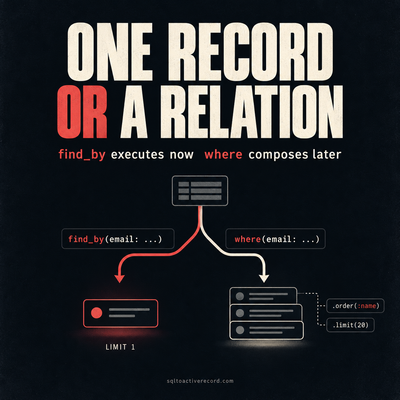
ActiveRecord where vs find_by — Which to Use When
where returns a relation, find_by returns one record or nil. Here's when each is correct, what breaks if you pick wrong, and Rails 7/8 production patterns.

Rails Counter Cache—When Posts.count Brought Down Production
posts.count hit the database on every request and brought down production. Here's how counter cache fixes it, what to watch for, and how to backfill safely.

SQL Certification on Resume. Rails Interview Failed. Knew Databases. Didn't Know ActiveRecord.
I had SQL certification on my resume and failed a Rails interview. Knowing databases and knowing ActiveRecord are two different skills. Here's the gap.
Leave a Response
Responses (0)
No responses yet
Be the first to share your thoughts