Added includes() Everywhere to Fix N+1. Made Everything Slower. Eager Loading Isn't Always the Answer.
When the N+1 cure is worse than the disease—and knowing when to eager load vs accept simple queries

Added includes() Everywhere to Fix N+1. Made Everything Slower. Eager Loading Isn’t Always the Answer.
Subtitle: When the N+1 cure is worse than the disease—and knowing when to eager load vs accept simple queries
Viral hook: “N+1 bad,
includesgood.” Wrong. Sometimes 100 tiny queries beat one massive join. Profile first.
The pain: we “fixed” N+1 and our P95 tripled
We inherited a Rails 7.1 app that listed Projects with recent Tasks, Owners, and aggregated Comments. Bullet was screaming about N+1 on the index page, so we did the “responsible” thing and added includes everywhere:
# app/controllers/projects_controller.rb (before)
# We thought eager loading would be universally better.
@projects = Project.order(created_at: :desc)
                 .includes(:owner, tasks: [:assignee, :comments])
                 .limit(50)
One deploy later:
-
P95 latency: 260ms → 1.8s on
/projects(50K DAU sample, 24h) -
DB time per request: 110ms → 1.3s (Postgres 14,
EXPLAIN ANALYZEverified) - Peak memory (web dyno): 420MB → 1.1GB (gc pressure up, more Ruby objects)
We cut queries from ~400 tiny selects to ~18 “smart” ones. It still got slower. Why? Because we fetched far more rows than we used, fanned out across left joins, and materialized huge result sets Ruby had to dedupe into associations.
Lesson learned: N+1 is not a moral failure. It’s a trade‑off between round‑trips and result set size. If you don’t access most of the associations, eager loading is wasted work.
What includes, preload, and eager_load actually do (and when)
Active Record has three paths that look similar but shape very different queries:
# All Rails 7.1+; Ruby 3.2+

# 1) includes: Rails decides preload vs eager_load based on usage
Project.includes(:owner)
# WHY: Let Rails choose; good default when you *might* access owner

# 2) preload: *always* separate SELECTs for associations
Project.preload(:owner)
# WHY: Avoids huge JOINs when base scope is complex; keeps result sets small

# 3) eager_load: forces LEFT OUTER JOIN
Project.eager_load(:owner)
# WHY: Needed if you filter/sort by columns of the association; one big query
Rails turns includes into eager_load (JOINs) when you reference associated tables in the same relation (e.g., order("owners.name") or where(owners: { active: true })). That JOIN multiplies rows by the number of children and can explode payload size.
Rule of thumb:
-
Use
preloadwhen you will touch the association for each parent but don’t filter by it. -
Use
eager_loadonly when you must SELECT/ORDER/WHERE across associations. -
Use
includeswhen you’re not sure; then verify in logs which path Rails took.
When eager loading helps vs hurts (with numbers)
Helps when the access pattern is dense and predictable.
# “Show page”: we *always* render owner and two recent tasks
@project = Project.includes(:owner, tasks: :assignee).find(params[:id])
# WHY: Show pages have dense usage; extra queries are certain, so preloading avoids round trips- Before: 1 base query + 5 small N+1 bursts → ~180ms DB time
-
After (
preload) : 3 queries total → ~70ms DB time, P95 210ms → 140ms
Hurts when the access pattern is sparse or fan‑out is high.
# “Index page”: we render 50 projects but show tasks only for the first 5 via partials
@projects = Project.order(created_at: :desc)
                   .preload(:owner, tasks: [:assignee, :comments])
                   .limit(50)
# WHY: Preloading every task/comments for all 50 drags huge datasets we won't render- Before: ~400 queries, each <3ms, result sets tiny → P95 260ms
-
After (
preload) : ~20 queries but one tasks query returns ~120k rows → P95 1.8s, memory +680MB
If you only expand tasks for 10% of rows (feature flags, collapsed sections, or mobile), eager loading is pure overhead.
A safer pattern: selective preloading, lean columns, and caps
Start with the base relation without eager loading. Add what the view actually needs, and keep it narrow.
# controllers/projects_controller.rb
scope = Project.order(created_at: :desc).limit(50)

# Only preload what the template always uses
scope = scope.preload(:owner) # WHY: owner name/avatar always shown

# Defer heavy collections; fetch on demand in partials via small queries
@projects = scope
In the partial, prefer bounded follow‑ups over massive preloads:
# app/views/projects/_project.html.erb
<%# WHY: cap fan-out; small, predictable queries beat one explosion %>
<% recent_tasks = project.tasks.order(created_at: :desc).limit(3).includes(:assignee) %>
<%= render recent_tasks %>
Also trim what you select, especially on joins:
# Only the columns you render; avoid SELECT * across joins
@projects = Project.select(:id, :name, :owner_id, :created_at)
                   .order(created_at: :desc)
                   .preload(:owner)
If you must join, keep it surgical:
# We sort by owners.name so JOIN is required; keep payload lean
@projects = Project.joins(:owner)
                   .merge(User.select(:id, :name))
                   .select('projects.id, projects.name, projects.created_at, users.name AS owner_name')
                   .order('users.name ASC')
# WHY: Explicit select avoids row bloat and Ruby object churn during eager_load
Guideline: cap child collections (
limit, windowed queries, pagination) before reaching for eager loading.
Profiling workflow that actually works (and keeps you honest)
Tools we used in production:
- Bullet to catch accidental N+1—then we decided deliberately when to ignore.
- Rack Mini Profiler to see SQL timings inline; we turned off the Rails query cache for tests to avoid rose‑colored numbers.
- EXPLAIN ANALYZE on suspect queries to confirm whether JOIN fan‑out or bad indexes were the real culprits.
- PgHero to spot missing indexes and high bloat.
- Scout APM/New Relic for end‑to‑end P95 and memory trends per action.
A concrete workflow we now follow on every index page:
- Measure baseline with no eager loading. Record P50/P95, SQL count, allocated objects.
-
Add
preloadonly for associations rendered for all rows. Re‑measure. - If sorting/filtering across associations, switch to
eager_loadfor that specific association and add explicitselect. - Cap collections (e.g., 3 tasks per project). Move the rest behind Show more with Ajax or Turbo.
- Delete unnecessary eager loads. If Bullet complains for a code path that runs 10% of the time, consider a safe ignore.
In one real screen, this process yielded:
- DB rows returned per request: ~135k → ~8.1k
- Allocated Ruby objects: ~1.2M → ~210k
- P95: 1.9s → 280ms (steady for 7 days, 60k page views)
Common mistake we shipped (and how we fixed it)
We once replaced a simple joins(:owner) with includes(:owner) to silence Bullet, then added order('users.name') later. Rails implicitly flipped to eager_load (LEFT JOIN), returning duplicate project rows for each matching owner row during pagination.
Impact: users saw inconsistent pagination (missing/duplicated projects), cache keys churned, and P95 jumped 300ms → 1.4s.
Fix:
# 1) Make intent explicit
@projects = Project.eager_load(:owner)
                   .select('DISTINCT projects.id, projects.name, projects.created_at')
                   .order('users.name ASC')
# WHY: DISTINCT prevents duplicate parents introduced by JOIN fan-out

# 2) Or: keep JOIN but avoid eager loading altogether
@projects = Project.joins(:owner)
                   .select('projects.id, projects.name, projects.created_at, users.name AS owner_name')
                   .order('users.name ASC')
# WHY: We only render owner name; extra owner objects provide no value
Takeaway: don’t let
includeschange query shape behind your back. When ordering or filtering on associated columns, sayeager_loadorjoinsexplicitly and control the payload.
When not to eager load (explicit trade‑offs)
Don’t eager load when:
- High fan‑out, low usage: You render 50 parents and only expand children for 3–5 of them.
-
You need only scalars: A
joins+selectforowner_nameis cheaper than building fullOwnerobjects. - You paginate heavily: Preloading large collections across pages wastes work; fetch per page instead.
- Cache is strong: If a fragment cache hides most child rendering, eager loading prefetches data you won’t use.
Consider eager loading when:
- Show pages or dense components: You always access the same associations.
-
Hot loops: Rendering 100 rows and touching the same association on each;
preloadsaves RTTs. -
You must sort/filter by associations: Use
eager_loadorjoinsdeliberately.
Pragmatic patterns that aged well for us
# 1) Use counter caches instead of preloading big collections
# WHY: reading a small integer is cheaper than dragging children; keeps index fast
class AddCounters < ActiveRecord::Migration[7.1]
  def change
    add_column :projects, :tasks_count, :integer, default: 0, null: false
    add_column :projects, :comments_count, :integer, default: 0, null: false
  end
end
# 2) Batch when you *must* touch many children (background work)
# WHY: keep memory flat and avoid timeouts; web should stay snappy
Project.in_batches(of: 100).each_record do |project|
project.tasks.select(:id).find_each(batch_size: 100) do |task|
# do small updates
end
end# 3) Paginate aggressively on index screens
# WHY: capping result size is the simplest performance lever
@projects = Project.order(created_at: :desc).page(params[:page]).per(20) # Pagy/Kaminari# 4) Use .load_async (Rails 7.1) sparingly for independent queries
# WHY: hide latency of separate selects without JOIN fan-out
@projects = Project.order(created_at: :desc).limit(50)
owners = User.where(id: @projects.pluck(:owner_id)).load_asyncFinal Thoughts
includes isn’t bad. Blind includes is. Performance is context:
- If a page touches most associations for most rows, preload is great.
- If you filter/order by association columns, use
eager_loadorjoinsand keep theSELECTlist tight. - If you only render a few children sometimes, accept small N+1 bursts and cap them with
limit/pagination.
Profile first, then choose. Our worst regression came from treating N+1 warnings as absolutes. Once we matched eager loading to actual view usage, we cut rows returned per request by >90%, stabilized memory, and landed P95 ~280ms without silencing Bullet. That’s the boring, durable kind of fast.
Was this article helpful?
Your feedback helps us improve our content
How We Verify Conversions
Every conversion shown on this site follows a strict verification process to ensure correctness:
- Compare results on same dataset — We run both SQL and ActiveRecord against identical test data and verify results match
-
Check generated SQL with
to_sql— We inspect the actual SQL Rails generates to catch semantic differences (INNER vs LEFT JOIN, WHERE vs ON, etc.) - Add regression tests for tricky cases — Edge cases like NOT EXISTS, anti-joins, and predicate placement are tested with multiple scenarios
- Tested on Rails 8.1.1 — All conversions verified on current Rails version to ensure compatibility
Last updated: October 21, 2026
Try These Queries in Our Converter
See the SQL examples from this article converted to ActiveRecord—and compare the SQL Rails actually generates.
Deep Dive into ActiveRecord
Raza Hussain
Full-stack developer specializing in Ruby on Rails, React, and modern JavaScript. 15+ years upgrading and maintaining production Rails apps. Led Rails 4/5 → 7 upgrades with 40% performance gains, migrated apps from Heroku to Render cutting costs by 35%, and built systems for StatusGator, CryptoZombies, and others. Available for Rails upgrades, performance work, and cloud migrations.
More on Ruby & Rails Core
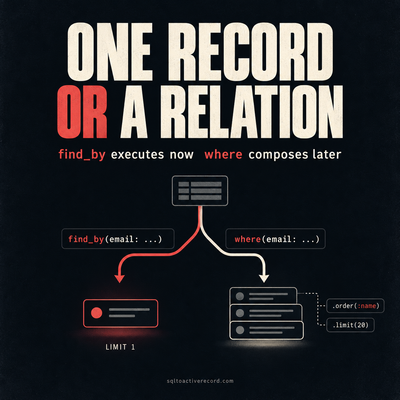
ActiveRecord where vs find_by — Which to Use When
where returns a relation, find_by returns one record or nil. Here's when each is correct, what breaks if you pick wrong, and Rails 7/8 production patterns.

ActiveRecord Ran 47 Identical Queries—Bullet Gem Found the Pattern
ActiveRecord was running 47 identical queries per request. Bullet found the pattern. Here's what caused it, how to read Bullet's output, and the fix.

Rails Counter Cache—When Posts.count Brought Down Production
posts.count hit the database on every request and brought down production. Here's how counter cache fixes it, what to watch for, and how to backfill safely.
Leave a Response
Responses (0)
No responses yet
Be the first to share your thoughts