Rails 8.2 Preview: What Production Apps Actually Gain in 2026
Early look at Solid Cache improvements, native TypeScript support, and Turbo 8 features

Rails 8.2 Preview: What Production Apps Actually Gain in 2026
Rails previews are easy to skim and hard to trust.
Most posts list features. Real teams care about something else:
What breaks in production if we upgrade — and what actually gets safer?
Rails 8.2 is not a flashy release. It’s a defaults-and-integration release. Those are the ones that quietly change behavior in production systems.
This post focuses on what actually matters.
The wrong mental model of Rails previews
Many teams assume:
- Preview features are “opt-in”
- Defaults don’t affect existing apps
- Tooling changes only affect developer experience
That’s not how Rails evolves.
Rails previews signal future defaults, and defaults are where production bugs come from.
Native TypeScript support
The wrong assumption
“TypeScript support just helps the frontend team.”
What’s actually changing
Rails 8.2 previews tighter, first-class TypeScript integration:
- Generators align with Rails paths
- Asset tooling becomes framework-aware
- Less custom glue between JS builds and Rails
Why this breaks apps today
In many production apps:
- TS builds succeed locally
- CI builds differ
- Production assets miss files or source maps
This is not a frontend issue. It’s a deployment correctness issue.
Rails tightening this integration reduces config drift — one of the most common causes of broken releases.
Solid Cache moving toward default behavior
The dangerous assumption
“All Rails cache stores behave the same.”
They don’t.
What Solid Cache changes
Solid Cache is:
- Process-local
- Memory-backed
- Fast
- Non-shared across workers
That’s fundamentally different from Redis.
Where production bugs appear
Given:
Rails.cache.fetch("user:#{user.id}:dashboard") do
  expensive_query
end
With Redis:
- Shared across workers
- Predictable TTL behavior
With Solid Cache:
- Cache lives per process
- Multiple workers = multiple cache entries
- Eviction behavior differs
If your app assumes shared cache state, you will see inconsistencies under load.
Rule
If consistency across processes matters, explicitly configure your cache store. Never rely on defaults during major upgrades.
Turbo 8 improvements are not “just UI”
The wrong mental model
“Turbo updates only affect frontend behavior.”
Reality
Turbo changes affect:
- Stream reconnect behavior
- Frame invalidation timing
- Broadcast consistency
In production systems with:
- Multiple app servers
- Rolling deploys
- Background broadcasts
These details determine whether users see stale UI or broken live updates.
Example risk area
<%= turbo_stream_from "tenant_#{current_tenant.id}" %>Turbo 8 improves consistency — but changes assumptions about reconnects. Tests that previously passed may now hide race conditions.
System tests must explicitly cover these flows.
What to verify before upgrading
Do not upgrade blindly.
Checklist:
- Run asset builds with TypeScript in CI
- Test cache behavior with multiple Puma workers
- Verify Turbo streams across deploys
- Lock critical defaults explicitly in config
Previews are signals — not guarantees.
Final rule of thumb
Rails upgrades fail at the boundaries: caching, assets, and concurrency.
Rails 8.2 improves those areas — but only if you understand what changed and make defaults explicit.
Predictability beats magic.
Was this article helpful?
Your feedback helps us improve our content
How We Verify Conversions
Every conversion shown on this site follows a strict verification process to ensure correctness:
- Compare results on same dataset — We run both SQL and ActiveRecord against identical test data and verify results match
-
Check generated SQL with
to_sql— We inspect the actual SQL Rails generates to catch semantic differences (INNER vs LEFT JOIN, WHERE vs ON, etc.) - Add regression tests for tricky cases — Edge cases like NOT EXISTS, anti-joins, and predicate placement are tested with multiple scenarios
- Tested on Rails 8.1.1 — All conversions verified on current Rails version to ensure compatibility
Last updated: October 14, 2026
Try These Queries in Our Converter
See the SQL examples from this article converted to ActiveRecord—and compare the SQL Rails actually generates.
Deep Dive into ActiveRecord
Raza Hussain
Full-stack developer specializing in Ruby on Rails, React, and modern JavaScript. 15+ years upgrading and maintaining production Rails apps. Led Rails 4/5 → 7 upgrades with 40% performance gains, migrated apps from Heroku to Render cutting costs by 35%, and built systems for StatusGator, CryptoZombies, and others. Available for Rails upgrades, performance work, and cloud migrations.
More on Ruby & Rails Core
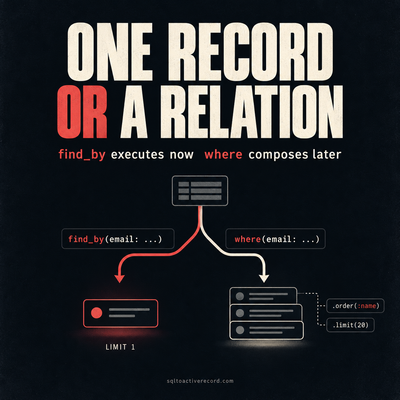
ActiveRecord where vs find_by — Which to Use When
where returns a relation, find_by returns one record or nil. Here's when each is correct, what breaks if you pick wrong, and Rails 7/8 production patterns.

Ruby 4.0.0 Is Out: What Rails & ActiveRecord Devs Actually Need to Know
Ruby 4.0.0 is out. For Rails developers, here's what actually changes: removed APIs, performance gains, and the breaking changes that hit ActiveRecord.
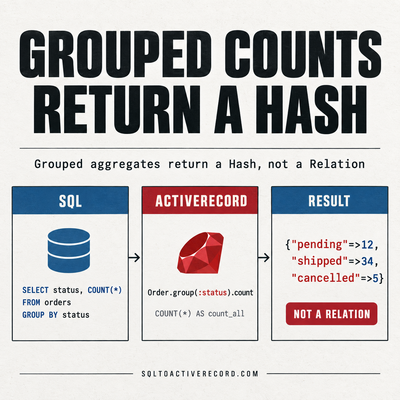
ActiveRecord group and count — SQL GROUP BY in Rails
How to use group and count in ActiveRecord for SQL GROUP BY. With having, order, and the SQL Rails generates. Rails 7/8 production examples with output.
Leave a Response
Responses (0)
No responses yet
Be the first to share your thoughts