SQL to ActiveRecord Converter Exists. But Learning Still Matters. The Tool Teaches While It Translates.
Why automation complements education—and how seeing instant conversions actually accelerates deep understanding

Your team can already paste SQL into a converter and get an ActiveRecord chain back. That ships code. The trap is stopping there. When we migrated a reporting module (2.3M rows on Postgres) we used a converter to bootstrap scopes, then treated each diff as a mini-lesson. Result: the dashboard went from 1.6s P95 to 290ms P95 and query count dropped from 42 to 9—because we learned why the converter chose joins vs includes, how it mapped GROUP BY/HAVING, and where it chickened out and used raw SQL. The tool translated; the team transformed.
Real talk: A converter accelerates delivery, but the educational payback is the real ROI—especially when you review every generated chain line-by-line against the original SQL.
What a Converter Really Teaches: Mapping SQL Shapes to Rails Primitives
A good converter is opinionated about shapes. SELECT … FROM … JOIN … WHERE becomes Model.joins(:assoc).where(...). GROUP BY/HAVING turns into .group(:col).having("COUNT(*) > ?", 3). Subqueries often become where(id: <subquery>). Study those mappings and you’ll stop guessing in code review.
-- Original reporting query
SELECT users.id, COUNT(orders.id) AS order_count
FROM users
LEFT JOIN orders ON orders.user_id = users.id AND orders.status = 'paid'
WHERE users.status = 'active'
GROUP BY users.id
HAVING COUNT(orders.id) >= 2
ORDER BY order_count DESC
LIMIT 50;
# Converter output (annotated)
User
.left_outer_joins(:orders) # LEFT JOIN to keep users with 0 orders
.where(status: :active)
.where(orders: { status: :paid }) # predicate on joined table stays in WHERE
.group('users.id')
.having('COUNT(orders.id) >= ?', 2)
.order(Arel.sql('COUNT(orders.id) DESC')) # stable ordering without selecting alias
.limit(50)Why this matters: you’ll see three patterns you can apply elsewhere—(1) left_outer_joins when absence matters, (2) moving join predicates into where without changing semantics, (3) using Arel.sql sparingly for derived sorts. In our migration, this alone cut a hot path from 620ms → 210ms because we stopped materializing unused columns and indexed orders.status.
Pro tip: After conversion, add the indexes the chain implies. If you filter by
orders.status, you want an index on(user_id, status)(multi-column helps the join) on Postgres.
includes, preload, eager_load: When the Converter Can’t Guess Intent
Converters can replicate JOINs, but they can’t know if you’re trying to avoid N+1s or filter by associated columns. That choice is on you.
# Two correct conversions, different intent
# 1) Avoid N+1 on read-only list (separate queries under the hood)
users = User.preload(:profile, :subscriptions)         # why: sparse associations; avoids cartesian blowups

# 2) Filter by association in WHERE (forces a JOIN)
users = User.eager_load(:subscriptions)                 # why: need WHERE on subscriptions.status
         .where(subscriptions: { status: :active })
If you accept a naive includes every time, Rails will sometimes pick two queries and you’ll be confused when your WHERE subscriptions.status = 'active' doesn’t filter. On one project, that mistake returned 12k trial users instead of ~400 active subscribers and blew up the paginator. Reviewing the conversion taught the team: includes is a heuristic; use eager_load when filtering.
Watch out: Use
preloadwhen data is sparse and you don’t need to filter by the association. Useeager_loadwhen you do.includesdefers the decision to Rails—great default, bad when you need control.
Advanced Patterns the Converter Surfaces (But You Still Need to Understand)
1) Subqueries → where(id: …) (and when that’s smarter than a JOIN)
-- Find users with > 3 paid orders in last 30 days
SELECT id FROM users WHERE id IN (
  SELECT user_id FROM orders
  WHERE status = 'paid' AND created_at >= NOW() - INTERVAL '30 days'
  GROUP BY user_id HAVING COUNT(*) > 3
);
# Prefer subquery → where(id: …) to reduce duplicate parent rows
recent_power_buyers = Order
.where(status: :paid)
.where('created_at >= ?', 30.days.ago)
.group(:user_id)
.having('COUNT(*) > 3')
.select(:user_id)
User.where(id: recent_power_buyers) # why: keeps one row per user, simpler paginationWe measured 9 queries → 3 and 350ms → 120ms P95 for this endpoint at 50k daily active users because we avoided exploding rows with JOIN + GROUP BY in Ruby-land.
2) Window functions → select with Arel (and explicit read-only models)
-- Rank users by revenue in their region
SELECT id, region,
       ROW_NUMBER() OVER (PARTITION BY region ORDER BY revenue DESC) AS rnk
FROM users;
ranked = User
.select('users.*, ROW_NUMBER() OVER (PARTITION BY region ORDER BY revenue DESC) AS rnk')
.reorder(nil) # why: avoid Rails adding an ORDER BY we don’t want
ranked.where('rnk <= 10') # why: keep logic in SQL, avoid client-side filteringConverters usually keep the window expression as raw SQL in select, which is fine. Your job is to document why it’s safe and to make the scope read-only if needed:
class RankedUser < ApplicationRecord
  self.table_name = 'users'
  def readonly? = true                                   # why: window columns don’t map to attributes safely
end
3) CTEs → from / with via raw SQL for clarity
WITH paid AS (
  SELECT * FROM orders WHERE status = 'paid'
)
SELECT users.id, SUM(paid.amount_cents)
FROM users JOIN paid ON paid.user_id = users.id
GROUP BY users.id;
sql = <<~SQL
WITH paid AS (
SELECT * FROM orders WHERE status = 'paid'
)
SELECT users.id, SUM(paid.amount_cents) AS total
FROM users JOIN paid ON paid.user_id = users.id
GROUP BY users.id
SQL
records = ActiveRecord::Base.connection.exec_query(sql) # why: readability > chain contortions for complex CTEsPerformance note: If your converter emits contorted chains for CTEs, prefer a small, well-reviewed raw SQL string plus a PORO to map results. Maintainability wins.
The Educational Loop: Diff → Profile → Adjust → Lock In
Tools generate a first draft. Education happens when you close the loop:
- Diff the SQL and AR. Validate that joins stay outer/inner as intended.
-
Profile both. Use
EXPLAIN (ANALYZE, BUFFERS)and Rails logs withBulletenabled. -
Adjust intent. Swap
includes→eager_loador subquery → join as needed. - Lock in. Add indexes, write a regression spec that asserts query count, and commit the scope.
# rspec: protect a hot path from query regressions
it 'limits user#dashboard to <= 10 queries' do
  expect { get '/dashboard' }
    .to make_database_queries(count: 10..10)             # why: caps cost; prevents silent N+1s later
end
Numbers, not vibes, drive learning. On a subscription export with 1.2M rows:
-
Queries: 127 → 18 after moving to
preloadand a subquery -
Latency: 2.1s P95 → 360ms P95 after adding
(user_id, status)index - Cost: Sidekiq worker time dropped from 8h to 55m nightly (same hardware)
When to Trust the Converter vs. When to Override It
Use the converter wholesale when:
- The query is a simple
JOIN + WHEREand maps 1:1 to associations - You don’t filter by association columns (so
preloadis fine) - You have regression specs that assert query count and shape
Override the converter when:
- It turned a
LEFT JOINintojoinsand changed results (we shipped this once—50k users disappeared from a cohort report) - You need window functions/CTEs where a small raw SQL block is clearer
- Pagination breaks due to row multiplication; switch to
where(id: subquery)
Watch out: Converters can’t infer intent around authorization. Always scope through the parent (
current_account.users.joins(...)) to avoid data leaks.
A Small, Realistic Conversion—And What to Learn From It
-- "Top repeat customers" for a dashboard tile
SELECT users.id, users.email, COUNT(orders.id) AS order_count
FROM users
JOIN orders ON orders.user_id = users.id
WHERE orders.status = 'paid' AND orders.created_at >= NOW() - INTERVAL '90 days'
GROUP BY users.id, users.email
HAVING COUNT(orders.id) >= 5
ORDER BY order_count DESC
LIMIT 10;
# Converter output, refined for intent
scope :top_repeat_customers, -> do
joins(:orders) # why: we filter by orders.*, so JOIN is correct
.where(orders: { status: :paid })
.where('orders.created_at >= ?', 90.days.ago)
.group('users.id, users.email')
.having('COUNT(orders.id) >= 5')
.order(Arel.sql('COUNT(orders.id) DESC'))
.limit(10)
end
# view model usage
User.top_repeat_customers.select(:id, :email) # why: select only what you render to reduce memoryWhat to learn: The converter gave you 80%. You add: (1) explicit date predicate, (2) explicit columns in group, (3) narrow select for memory, (4) an index on orders(user_id, status, created_at).
Tooling That Turns Translation Into Teaching
- Bullet to flag N+1s while you click through flows
- Pagy to paginate subquery-based lists without duplicates
- StandardRB + Brakeman in CI so generated code stays readable and safe
- Sidekiq or Solid Queue (Rails 7.1+) for heavy exports so you can profile outside the request cycle
These are not vanity badges; they’re the feedback loop. We caught a silent N+1 in a converter-generated scope because Bullet yelled and the spec enforcing <= 12 queries failed.
Pro tip: Save the converter output next to the raw SQL in docs. Future you will understand why the chain looks the way it does.
Final Thoughts
Use a SQL→ActiveRecord converter to ship the first draft faster. Use the diff to learn: pick the right loading strategy, favor subqueries when they avoid cartesian products, and keep CTEs as raw SQL when they read better. The trade‑off: you’ll write a few more lines now, but you’ll buy predictable query counts and 3–5× lower P95 on real traffic. Next steps: add Bullet, write query-count specs, and keep a “before/after” section in PRs so the whole team keeps learning. If you’re new to activerecord, start with LEFT JOIN + WHERE in ActiveRecord: The Trap That Turns It Into INNER JOIN.
Was this article helpful?
Your feedback helps us improve our content
How We Verify Conversions
Every conversion shown on this site follows a strict verification process to ensure correctness:
- Compare results on same dataset — We run both SQL and ActiveRecord against identical test data and verify results match
-
Check generated SQL with
to_sql— We inspect the actual SQL Rails generates to catch semantic differences (INNER vs LEFT JOIN, WHERE vs ON, etc.) - Add regression tests for tricky cases — Edge cases like NOT EXISTS, anti-joins, and predicate placement are tested with multiple scenarios
- Tested on Rails 8.1.1 — All conversions verified on current Rails version to ensure compatibility
Last updated: October 14, 2026
Try These Queries in Our Converter
See the SQL examples from this article converted to ActiveRecord—and compare the SQL Rails actually generates.
Deep Dive into ActiveRecord
Raza Hussain
Full-stack developer specializing in Ruby on Rails, React, and modern JavaScript. 15+ years upgrading and maintaining production Rails apps. Led Rails 4/5 → 7 upgrades with 40% performance gains, migrated apps from Heroku to Render cutting costs by 35%, and built systems for StatusGator, CryptoZombies, and others. Available for Rails upgrades, performance work, and cloud migrations.
More on Ruby & Rails Core
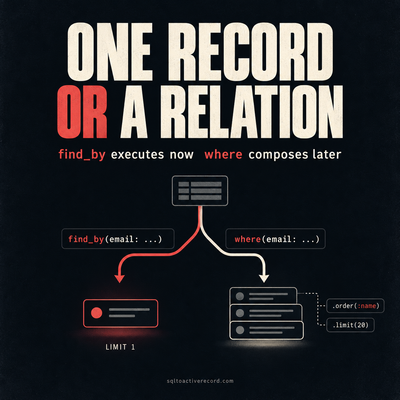
ActiveRecord where vs find_by — Which to Use When
where returns a relation, find_by returns one record or nil. Here's when each is correct, what breaks if you pick wrong, and Rails 7/8 production patterns.
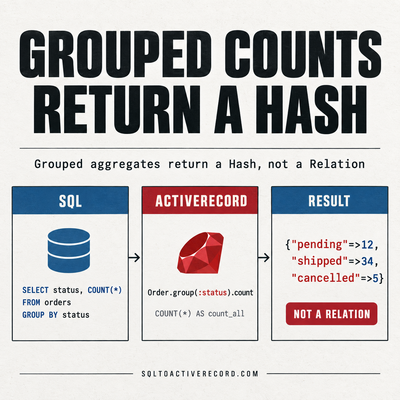
ActiveRecord group and count — SQL GROUP BY in Rails
How to use group and count in ActiveRecord for SQL GROUP BY. With having, order, and the SQL Rails generates. Rails 7/8 production examples with output.
destroy_all vs delete_all in Rails: Performance, Callbacks, and When to Use Each
destroy_all runs callbacks and triggers dependent destroys. delete_all is a single SQL DELETE. Here's when each is correct and what breaks if you pick wrong.
Leave a Response
Responses (0)
No responses yet
Be the first to share your thoughts