Ruby 4.0.0 Is Out: What Rails & ActiveRecord Devs Actually Need to Know
The upgrade is mostly smooth—but a few stdlib and tooling changes will bite production first

Ruby 4.0.0 Is Out: What Rails & ActiveRecord Devs Actually Need to Know
Start from a real production bug
You upgrade Ruby on a mature Rails app. CI is green. You deploy.
Then a background job dies with:
LoadError: cannot load such file -- cgi/sessionOr your sitemap/health-check ping starts failing.
Nothing in your code mentions CGI. A gem does.
Ruby 4.0 didn’t “break Rails”. Ruby 4.0 changed what ships by default.
That’s the theme of this release for Rails apps: small, sharp compatibility edges + tooling shifts, not a new language you need to relearn.
Ruby 4.0.0 was released on December 25, 2025. For details, see the official announcement: https://www.ruby-lang.org/en/news/2025/12/25/ruby-4-0-0-released/
The wrong mental model
Wrong model #1: “Major version = everything breaks”
Ruby doesn’t follow SemVer strictly, and Ruby 4.0 is largely a commemorative release. Most Rails code will run fine.
Wrong model #2: “Ruby upgrade = free app speedup”
Ruby 4.0 has real performance and GC improvements, and YJIT keeps getting better—but your slowest endpoints are still usually:
- N+1 queries
- missing indexes
- huge object graphs loaded unnecessarily
- inefficient write paths
Ruby can make good code faster. It can’t make bad query shapes disappear.
Why the naive upgrade fails
1) Stdlib gem boundaries moved (CGI is the headline)
Ruby 4.0 removes the full CGI library from the default gems. Only cgi/escape remains for a small set of escaping helpers.
Symptom
-
LoadErrorforcgi,cgi/session,cgi/util, etc. - Often triggered by a gem in production-only code paths (sitemap pings, legacy integrations, admin tasks).
Fix options
- If you only needed escaping, stop requiring
cgi:require "cgi/escape" CGI.escape("a b") # ok - If you truly need CGI features, vendor the dependency explicitly:
- add the
cgigem (or update the gem that still requires it)
- add the
Production-safe move
- grep your codebase for
cgi/requires - run a boot/test job in production-like mode (same bundle groups, same env vars), not just
rails slocally
2) Net::HTTP stopped “helping” you
Ruby 4.0 removes Net::HTTP’s behavior of automatically setting
Content-Type: application/x-www-form-urlencoded when you send a request body without specifying a header.
If you had code like:
uri = URI("https://example.com/webhooks")
req = Net::HTTP::Post.new(uri)
req.body = "a=1&b=2" # no Content-Type set

Net::HTTP.start(uri.host, uri.port, use_ssl: true) { |http| http.request(req) }
Some servers will accept it. Some will reject it. The painful part: it depends on the downstream.
Fix Be explicit:
req["Content-Type"] = "application/x-www-form-urlencoded"Or, better: use a client that sets headers intentionally (Faraday / HTTParty), but still validate the wire output.
3) RubyGems/Bundler 4 is now part of the default toolchain
Ruby 4.0 bundles RubyGems and Bundler 4.
This matters because your “Ruby upgrade” is also a “tooling upgrade”:
- CI images might now resolve gems slightly differently
- scripts relying on old RubyGems CLI behavior may fail
-
bundle installbehavior can surface latent Gemfile issues
Safe approach
- pin bundler in CI if you need time to migrate
- run
bundle lockchanges explicitly and commit them - validate production boot with the exact same bundler version you deploy
The correct approach: treat Ruby 4.0 as a dependency boundary audit
Here’s a practical rollout sequence that catches the real failures early.
Step 1: upgrade Ruby without changing Rails (first)
- keep your Rails version steady
- run full test suite
- run a production boot smoke test (
rails runner, jobs, and the code paths you don’t hit locally)
Step 2: scan for “stdlib now missing” requires
In Rails apps, the offenders are usually not Rails—they’re transitive dependencies.
Checklist:
cgi/*- anything relying on
SortedSet(Ruby 4.0 removesset/sorted_set; you need thesorted_setgem) - custom Net::HTTP wrappers
Step 3: measure what you think Ruby 4.0 will improve
Ruby 4.0 adds an experimental new JIT (ZJIT) and continues improving YJIT. But the “Rails wins” often come from:
- less GC overhead
- faster object allocation paths
- faster method/ivar access
You still need to measure endpoints, jobs, and memory.
Verified SQL + ActiveRecord: Ruby won’t fix query shape
Here’s the trap Rails teams fall into during language upgrades:
“We upgraded Ruby, the app still feels slow, so Ruby 4.0 was hype.”
What actually happened: your bottleneck is still the database.
The classic bug: N+1 hidden in a view
@orders = Order.where(status: "open").order(created_at: :desc).limit(50)

# view:
@orders.each { |o| o.user.email }
Fix the shape first
@orders = Order
  .where(status: "open")
  .includes(:user)
  .order(created_at: :desc)
  .limit(50)
Now verify the SQL (don’t guess):
Rails.logger.info(@orders.to_sql)You should see a single orders query plus one users WHERE id IN (...) query,
not 51 queries in the logs.
Ruby 4.0 can make those two queries cheaper to handle in Ruby. It cannot turn 51 queries into 2.
Edge cases & production pitfalls
“Works locally, fails in production”
This usually means:
- different bundle groups
- different
BUNDLE_WITHOUT - different Bootsnap cache behavior
- different code paths (cron, jobs, background pings)
Run the failing task in a production-like environment:
- same Ruby
- same bundler
- same Gemfile.lock
- same environment variables
“We only use Rails, why is CGI involved?”
You don’t. Your dependencies do. The fix is still yours: either update the dependency or vendor the missing gem explicitly.
“Should we use ZJIT now?”
Ruby’s own guidance: ZJIT is faster than the interpreter, but not yet as fast as YJIT, and not recommended for production yet. If you want a production JIT story today, focus on YJIT.
“Can Ruby::Box help Rails?”
Ruby::Box is experimental and interesting (isolation, blue/green in-process, test isolation). But for Rails teams, it’s a future tool, not a current migration requirement.
Rule of thumb
Ruby 4.0 is not a scary Rails upgrade. It’s a dependency boundary upgrade.
Upgrade safely by assuming:
- one stdlib require will vanish (CGI is the big one)
- one HTTP integration will change behavior (Net::HTTP headers)
- your tooling will shift (Bundler 4)
- performance gains are real—but only after you fix query shape first
Was this article helpful?
Your feedback helps us improve our content
How We Verify Conversions
Every conversion shown on this site follows a strict verification process to ensure correctness:
- Compare results on same dataset — We run both SQL and ActiveRecord against identical test data and verify results match
-
Check generated SQL with
to_sql— We inspect the actual SQL Rails generates to catch semantic differences (INNER vs LEFT JOIN, WHERE vs ON, etc.) - Add regression tests for tricky cases — Edge cases like NOT EXISTS, anti-joins, and predicate placement are tested with multiple scenarios
- Tested on Rails 8.1.1 — All conversions verified on current Rails version to ensure compatibility
Last updated: October 14, 2026
Try These Queries in Our Converter
See the SQL examples from this article converted to ActiveRecord—and compare the SQL Rails actually generates.
Deep Dive into ActiveRecord
Raza Hussain
Full-stack developer specializing in Ruby on Rails, React, and modern JavaScript. 15+ years upgrading and maintaining production Rails apps. Led Rails 4/5 → 7 upgrades with 40% performance gains, migrated apps from Heroku to Render cutting costs by 35%, and built systems for StatusGator, CryptoZombies, and others. Available for Rails upgrades, performance work, and cloud migrations.
More on Ruby & Rails Core

Rails 8.2 Preview: What Production Apps Actually Gain in 2026
Rails 8.2 for production apps: caching, query performance, concurrency changes, and what actually breaks at scale. No hype, just impact. Updated 2026.
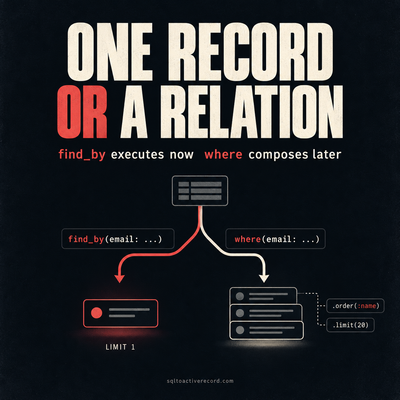
ActiveRecord where vs find_by — Which to Use When
where returns a relation, find_by returns one record or nil. Here's when each is correct, what breaks if you pick wrong, and Rails 7/8 production patterns.
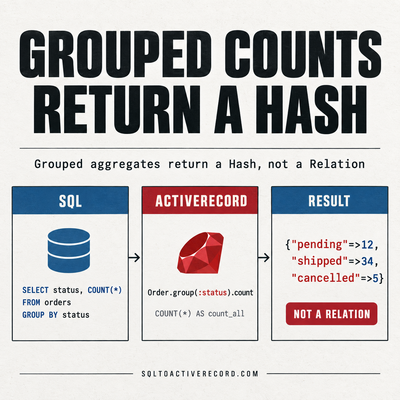
ActiveRecord group and count — SQL GROUP BY in Rails
How to use group and count in ActiveRecord for SQL GROUP BY. With having, order, and the SQL Rails generates. Rails 7/8 production examples with output.
Leave a Response
Responses (0)
No responses yet
Be the first to share your thoughts