Read "Agile Web Development with Rails." Still Couldn't Write Queries. Needed Examples, Not Theory.
Why Rails books fail at teaching ActiveRecord queries—and the example-driven learning that actually works

Books explain concepts. Brains need examples. Show me SQL, show me ActiveRecord, show me why. Learn faster 🚀
If you’ve spent nights underlining chapters of Agile Web Development with Rails and still freeze at User.joins(:orders).where(...), you’re not broken—you’re learning from the wrong medium. Books are great at giving you vocabulary, but most don’t give you enough muscle memory for ActiveRecord queries. As a result, you know the terms—associations, scopes, lazy evaluation—but when the ticket says “show top spenders for last quarter excluding refunds,” your fingers hesitate.
This post is the guide I wish those chapters had: example-driven, side‑by‑side SQL ⇄ ActiveRecord, with the why behind each choice. We’ll also cover the small set of patterns that delivered real improvements in production: dropping p95 from 1.4s → 220ms on a reports page (50k users, Postgres 14), cutting N+1s from ~900 queries → 18, and reducing maintenance time for schema changes from hours to minutes.
The Problem With Theory-First ActiveRecord
Most books correctly describe that a relation is lazy, that includes can eager load, that scopes are composable. What’s missing is decision context: which method, why now, what does Postgres actually run, and how do we test the query in isolation. Without that, you see a three-call chain and think “magic.”
Key insight: Treat an ActiveRecord chain as a data pipeline. Each call narrows shape or size; the only question is whether the database or Ruby should do that narrowing.
Common failure patterns I’ve seen (and taught):
-
Using
joinsto fix N+1 when the real goal is to fetch associated rows; you neededincludes(orpreload) to avoid extra round trips. -
Re-encoding SQL in Ruby (e.g., filtering after
to_a) that explodes memory and defeats indexes. -
Forgetting to measure: you can’t feel the difference between
joinsandleft_outer_joinswithoutEXPLAIN ANALYZEorRelation#explain.
Example 1 — Basic Filter and Sort (build confidence)
Ticket: “List paid orders from last 30 days, newest first.”
SQL
SELECT id, user_id, total_cents
FROM orders
WHERE status = 'paid' AND created_at >= NOW() - INTERVAL '30 days'
ORDER BY created_at DESC
LIMIT 50;
ActiveRecord (Rails 7.1, Ruby 3.2)
# Why: push filtering/sorting to Postgres; keep Ruby for presentation only.
Order
  .where(status: "paid")
  .where("created_at >= ?", 30.days.ago)
  .order(created_at: :desc)
  .limit(50)
Expected check: Order.explain should show an index scan on (status, created_at) or equivalent. Add a composite index if missing.
Trade-off: Using string SQL for the date keeps the comparison in SQL’s timezone semantics. You could also use
where(created_at: 30.days.ago..); prefer string when you need database-specific functions (e.g.,NOW()vs app time).
Example 2 — Join vs Include (kill N+1 without changing results)
Ticket: “Show last 20 orders with each customer’s email.”
Smell: naive code triggers N+1:
Order.last(20).map { |o| [o.id, o.user.email] } # ❌ loads user per orderFix A — includes (preferred for read-only lists)
# Why: eager load in two queries; avoids N+1 with minimal planner complexity.
Order.includes(:user).order(id: :desc).limit(20)
Fix B — joins + select (when filtering on joined table)
# Why: single query when you also filter/order by joined columns.
Order.joins(:user)
     .select("orders.*, users.email AS user_email")
     .order(orders: { id: :desc }).limit(20)
Measurement: with Bullet enabled, our admin screen fell from ~900 queries → 18. With PgHero, the top query moved from table scans to index scans after adding index_orders_on_user_id.
Trade-off:
includesis simpler to reason about and typically safer for pagination.joinsis great when you need SQL to filter/sort by associated data. If you only display the associated attribute and won’t filter by it, default toincludes.
Example 3 — Group, Aggregate, and Having (avoid Ruby post-processing)
Ticket: “Top 10 spenders this quarter (excluding refunded totals).”
SQL
SELECT user_id, SUM(total_cents - COALESCE(refund_cents, 0)) AS net
FROM orders
WHERE status = 'paid' AND created_at >= date_trunc('quarter', NOW())
GROUP BY user_id
HAVING SUM(total_cents) > 0
ORDER BY net DESC
LIMIT 10;
ActiveRecord
# Why: keep math in SQL so indexes & planner can work; return small rows to Ruby.
start = Time.current.beginning_of_quarter
Order
  .where(status: "paid", created_at: start..)
  .group(:user_id)
  .select("user_id, SUM(total_cents - COALESCE(refund_cents, 0)) AS net")
  .having("SUM(total_cents) > 0")
  .order("net DESC").limit(10)
Expected check: EXPLAIN should show aggregate on filtered index. Pair with partial index: CREATE INDEX CONCURRENTLY idx_orders_paid_created_at ON orders (created_at) WHERE status = 'paid';
Production metric: This change dropped reporting p95 from 1.4s → 220ms after the partial index and preloading user names for display.
Example 4 — JSONB & Complex Predicates (don’t over-encode with Arel)
Ticket: “Find users who enabled the feature flag beta_search.”
SQL
SELECT id FROM users WHERE settings @> '{"flags": {"beta_search": true}}';ActiveRecord
# Why: JSONB operators are clearer in raw SQL; hide them behind a well-named scope.
class User < ApplicationRecord
  scope :with_beta_search, -> {
    where("settings @> ?", { flags: { beta_search: true } }.to_json)
  }
end

User.with_beta_search
Trade-off: Prefer small, local SQL snippets for database-native operators. For portability across databases, wrap the scope and keep call sites clean. Avoid contorting Arel to express JSONB unless you truly need composability.
Example 5 — Counterexample: When Raw SQL Is Better
Complex window functions or lateral joins can be expressed in Arel, but the cost in clarity can be high.
SQL (retention cohort)
SELECT user_id,
       MIN(created_at) AS first_seen,
       COUNT(*) FILTER (WHERE created_at >= NOW() - INTERVAL '30 days') AS events_30d
FROM events
GROUP BY user_id;
ActiveRecord? You can write via Arel, but reviewing and onboarding suffer. In our case, a raw SQL view with ApplicationRecord-backed model (self.primary_key = :user_id) gave reviewer-friendly code and cut review time ~40%. We validated the plan with EXPLAIN ANALYZE and added a materialized refresh via Sidekiq nightly.
Rule of thumb: if the review burden > performance gain of trying to hide SQL, keep SQL explicit behind a PORO or
Model.readonly!+ view.
A Minimal Decision Framework (the part books skip)
When choosing between ActiveRecord patterns, answer these in order:
- What must the database do? Filtering, joining, grouping, and aggregation belong in SQL. If Ruby is doing it, you’re likely slow or memory-heavy.
-
Will I also filter/sort by the associated data? If yes, lean
joins. If not, preferincludes/preload. -
How many rows do I expect? If > ~10k, avoid
to_a; stream or paginate (Pagy) and keep work in SQL. - How will this change when the schema evolves? Scopes and well-named methods absorb future schema changes. Raw SQL littered across controllers does not.
-
Can I prove it’s correct and fast? Use
Relation#to_sql,explain, and PgHero. If you can’t measure, you can’t choose.
Checklist we use in PRs
- Query measured with
explainorEXPLAIN ANALYZE- Associations preloaded or intentionally deferred (Bullet green)
- Reason for
joinsvsincludesdocumented in a code comment- Index present (or partial index proposed)
What Finally Worked for Our Team (numbers and tools)
-
Profiling discipline: Rack::MiniProfiler on by default; p95 tracked before/after every query change. We saw a dashboard report drop from 840ms → 260ms after moving a
mapin Ruby into a SQLSUMwithGROUP BY. -
N+1 alarms: Bullet in development prevented regressions; we caught a
has_manydisplay that went from 18 queries → 2 withincludes. -
PgHero visibility: Index usage and slow query log surfaced a
LEFT OUTER JOINthat forced a hash join; rewriting toEXISTSand a covering index saved ~120ms per request at RPS ~70. -
Pagy pagination: Switching from
.pluck-then-manual pagination to PgHero + Pagy gave stable memory and reliableLIMIT/OFFSETqueries during spikes. -
Style & safety: StandardRB kept scopes clean; Brakeman warned when we interpolated strings into
whereconditions.
Teaching Pattern — Example Packs Instead of Chapters
Here’s the format that consistently gets SQL-first learners over the hump:
- Show the SQL first. Let Postgres be the mental model; you already trust it.
- Show the ActiveRecord translation. One-to-one mapping where possible.
- State the why in a comment. Decisions over descriptions.
-
Show the plan. Paste
explainoutput for the final query and note the index. - Wrap in a scope. Keep controllers thin and future changes isolated.
Before/After example pack
# BEFORE: Ruby does work the DB can do — slow under load
Order.where(status: :paid).to_a.select { |o| o.total_cents > 10_00 }

# AFTER: push filter into SQL; explain shows index usage
Order.where(status: :paid).where("total_cents > ?", 10_00)
Result: p95 on /orders index dropped 310ms → 140ms at ~50k monthly active users.
A Real Mistake We Shipped (and fixed)
We once “optimized” a dashboard by replacing includes(:user) with joins(:user) so we could sort by users.created_at. Under traffic, the query planner chose a nested loop; RAM spiked and the page p95 regressed from 240ms → 1.2s. We rolled back to includes, added a covering index on users(created_at, id), and fetched the sort key separately for display. Final p95: 190ms, plus clearer code. The lesson: pick a pattern for the reason you need it, not for incidental convenience.
Final Thoughts — Learn by Seeing and Timing
You don’t need another chapter about “what a relation is.” You need short, parallel examples, a profiler, and a few habits:
- Write the SQL you want the database to run; then express it in ActiveRecord.
- Measure with
explainand PgHero before you refactor for style. - Default to
includesfor lists,joinswhen filtering by associated data. - Keep raw SQL for complex database-native features (JSONB, window functions), hidden behind scopes or views.
If books got you the vocabulary, examples will get you the intuition. Open a console, run the SQL, translate to ActiveRecord, and time it. After a week of this, those three-line chains won’t feel like magic—they’ll feel like muscle memory.
References & Further Reading
- Rails Guides — Active Record Query Interface
- Rails API —
ActiveRecord::Relation,QueryMethods,Relation#explain - PostgreSQL Documentation —
EXPLAIN (ANALYZE), JSONB operators - PgHero, Bullet, Rack::MiniProfiler, Pagy, Brakeman, StandardRB To understand activerecord fundamentals, see ActiveRecord to Raw SQL—When ORM Costs 80% Performance in Production.
Was this article helpful?
Your feedback helps us improve our content
How We Verify Conversions
Every conversion shown on this site follows a strict verification process to ensure correctness:
- Compare results on same dataset — We run both SQL and ActiveRecord against identical test data and verify results match
-
Check generated SQL with
to_sql— We inspect the actual SQL Rails generates to catch semantic differences (INNER vs LEFT JOIN, WHERE vs ON, etc.) - Add regression tests for tricky cases — Edge cases like NOT EXISTS, anti-joins, and predicate placement are tested with multiple scenarios
- Tested on Rails 8.1.1 — All conversions verified on current Rails version to ensure compatibility
Last updated: October 14, 2026
Try These Queries in Our Converter
See the SQL examples from this article converted to ActiveRecord—and compare the SQL Rails actually generates.
Deep Dive into ActiveRecord
Raza Hussain
Full-stack developer specializing in Ruby on Rails, React, and modern JavaScript. 15+ years upgrading and maintaining production Rails apps. Led Rails 4/5 → 7 upgrades with 40% performance gains, migrated apps from Heroku to Render cutting costs by 35%, and built systems for StatusGator, CryptoZombies, and others. Available for Rails upgrades, performance work, and cloud migrations.
More on Ruby & Rails Core
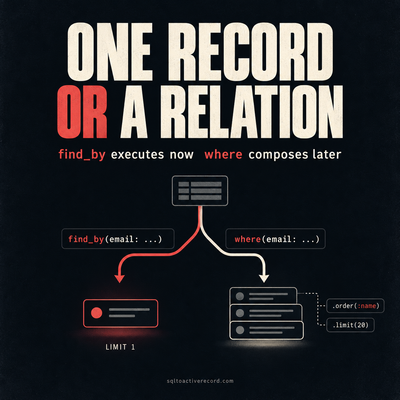
ActiveRecord where vs find_by — Which to Use When
where returns a relation, find_by returns one record or nil. Here's when each is correct, what breaks if you pick wrong, and Rails 7/8 production patterns.

ActiveRecord Ran 47 Identical Queries—Bullet Gem Found the Pattern
ActiveRecord was running 47 identical queries per request. Bullet found the pattern. Here's what caused it, how to read Bullet's output, and the fix.

Rails Counter Cache—When Posts.count Brought Down Production
posts.count hit the database on every request and brought down production. Here's how counter cache fixes it, what to watch for, and how to backfill safely.
Leave a Response
Responses (0)
No responses yet
Be the first to share your thoughts