Taught SQL for 5 Years. Teaching ActiveRecord Broke All My Analogies. Had to Unlearn to Teach.
Why SQL knowledge helps and hurts when learning ActiveRecord—and the fresh teaching perspective that actually works

“SQL analogies helped me learn. Same analogies hurt my teaching. ActiveRecord is not SQL in Ruby—it’s object mapping.”
When I started teaching Rails, I reused my trusty SQL classroom metaphors. Tables are classes. Rows are objects. SELECT is where. Everyone nodded…until they didn’t. Students wrote “perfectly valid” ActiveRecord that issued 200 queries on a list page. They hand‑translated JOINs and missed the point that we’re composing domain logic, not retyping SQL in camelCase.
After three cohorts and one embarrassing production incident (a feature flag page issuing 1,128 queries at p95=1.4s), I threw out the slide deck and rebuilt how I explain ActiveRecord. Here’s the approach that finally sticks for SQL‑savvy developers.
1) Start With the Mental Model: Relations, Not Tables
SQL pros think in sets. Keep that superpower—just shift the unit you reason about:
-
Relation: an ongoing query you can pass around (
ActiveRecord::Relation), not a finished array. - Composition over translation: you’re building a pipeline, not recreating a SELECT string.
-
Identity matters: an
Orderis a rich object with callbacks, validations, and associations—not just a row shape.
# Rails 7+, Ruby 3+
class Order < ApplicationRecord
  belongs_to :account
  has_many :line_items

  scope :recent, -> { where('orders.created_at >= ?', 30.days.ago) }
  scope :paid,   -> { where(status: 'paid') }
  scope :high_value, -> { where('total_cents >= ?', 50_00) }
end

# Why: these named scopes create a shared vocabulary you can compose,
# so future schema changes hit the scope in one place instead of 40 raw SQL strings.
Key shift: stop asking “How do I translate WHERE into Ruby?” Start asking “What concept do I want to compose and reuse?”
2) Replace SQL-to-Ruby Translation With a Teaching Ladder
I use a four‑rung ladder that keeps SQL skills but prevents string‑building reflexes.
-
Associations First —
belongs_to,has_many,has_many :through. - Scopes Next — tiny, composable predicates with parameters.
-
Preloading vs Joining —
includes,preload,eager_loadvsjoins. - Arel & Escape Hatches — only when composition hits a wall.
# Rung 1–2: associations + scopes
class Account < ApplicationRecord
  has_many :orders
  has_many :recent_paid_orders, -> { Order.recent.paid }, class_name: 'Order'
end

# Lesson WHY: students query through associations to avoid hand-writing foreign keys,
# which reduces mistakes when columns or table names change.
# Rung 3: preloading vs joining
# List accounts with total orders over $500, show first order number on the page
accounts = Account
.joins(:orders)
.merge(Order.paid)
.group('accounts.id')
.having('SUM(orders.total_cents) >= ?', 500_00)
.includes(:orders) # Why: first-order display without N+1
.select('accounts.*, SUM(orders.total_cents) AS total_spent')
# WHY: joins for filtering/aggregation; includes for rendering associated data.
# This combo keeps the SQL planner happy and the view N+1-free.# Rung 4: Arel when logic is too dynamic for plain scopes
orders = Order.arel_table
complex = Order.where(
orders[:status].eq('paid').and(
orders[:created_at].gt(30.days.ago).or(orders[:total_cents].gteq(50_00))
)
)
# WHY: complex boolean logic stays composable and safe, without string SQL.Teaching mantra: compose relations, don’t concatenate strings.
3) Show the Cost of “Looks Fine” Code (N+1s, query storms, and schema drift)
Early lessons must make invisible costs visible. I demo three tools on the projector and have students commit the changes:
-
Bullet screams on N+1 queries. First run on a naive index page: 201 queries → 9 queries after
includes(:orders, :line_items). p95 went from 820ms → 230ms on my sample dataset (120k orders, PostgreSQL 14 on a 2‑vCPU VM). -
Rack::MiniProfiler correlates query counts with view partials, so students see how
render @collectioncan nuke performance without preloading. -
PgHero surfaces missing indexes and slow queries. One cohort added a partial index (
CREATE INDEX ON orders (status) WHERE status='paid') and saw a 99th percentile drop from 2.8s → 320ms for a report endpoint.
# app/controllers/accounts_controller.rb
class AccountsController < ApplicationController
  def index
    Account
      .includes(orders: :line_items) # WHY: remove N+1s in the table and nested partial
      .strict_loading # Rails 7: WHY fail fast if the view triggers an unloaded association
      .order(created_at: :desc)
      .page(params[:page])
  end
end
# Gemfile (teaching baseline)
gem 'bullet'
gem 'rack-mini-profiler'
gem 'pghero'
gem 'standard' # WHY: consistent style lowers cognitive load while learningSchema drift lesson. I rename orders.status → orders.state in a migration and run tests. The class that used 12 raw SQL snippets explodes. The class using scopes and associations passes on the first try.
- Raw SQL cohort: 12 call sites edited, 42 lines touched.
- Scope cohort: 1 scope edited, 1 line touched.
The class stares, and the point lands.
4) Before/After: From Hand‑Written SQL to Composable Relations
Before (typical SQL‑first translation):
class RevenueReport
  def top_accounts(limit: 10)
    sql = <<~SQL
      SELECT a.id, a.name, SUM(o.total_cents) AS revenue
      FROM accounts a
      JOIN orders o ON o.account_id = a.id
      WHERE o.status = 'paid' AND o.created_at >= NOW() - INTERVAL '30 days'
      GROUP BY a.id, a.name
      HAVING SUM(o.total_cents) >= 50000
      ORDER BY revenue DESC
      LIMIT #{Integer(limit)}
    SQL
    ActiveRecord::Base.connection.exec_query(sql).to_a
  end
end
# WHY (anti‑pattern): string interpolation, duplicated predicates, and brittle to schema changes.
After (scopes + a tiny Arel assist):
class Order < ApplicationRecord
  scope :last_30_days, -> { where('orders.created_at >= ?', 30.days.ago) }
  scope :paid, -> { where(status: 'paid') }
end

class Account < ApplicationRecord
  has_many :orders

  scope :with_paid_revenue_since, ->(from) {
    joins(:orders)
      .merge(Order.where('orders.created_at >= ?', from).paid)
      .group('accounts.id')
      .select('accounts.*, SUM(orders.total_cents) AS revenue')
  }
end

class RevenueReport
  MIN_REVENUE = 50_000 # cents

  def top_accounts(limit: 10)
    Account
      .with_paid_revenue_since(30.days.ago)
      .having('SUM(orders.total_cents) >= ?', MIN_REVENUE)
      .order('revenue DESC')
      .limit(limit)
      .includes(:orders) # WHY: reuse in a view without extra queries
  end
end
Outcomes in class project:
- LOC down from 63 → 28 for the report object.
-
Predicate reuse: same
paid.last_30_dayspowers the dashboard and exports. - Safety: no string interpolation, fewer SQL‑injection surfaces; Brakeman stays quiet.
Expected result (console):
RevenueReport.new.top_accounts(limit: 3).map { |a| [a.id, a.revenue] }
# => [[42, 155_000], [7, 120_500], [19, 97_200]]
5) Teach the Escape Hatches—Without Apology
There are problems where SQL is the most honest tool. Students should learn to choose it, not default to it.
Use raw SQL / Arel when:
- You need window functions (
ROW_NUMBER,PERCENTILE_CONT). - You’re leveraging database‑specific operators (PostgreSQL
@>,?,ILIKE). - The query is report‑only and not reused as domain logic.
# Example: window function for ranking accounts without denormalizing
Account
  .select(<<~SQL)
    accounts.*, ROW_NUMBER() OVER (
      PARTITION BY plan_id ORDER BY SUM(orders.total_cents) DESC
    ) AS plan_rank
  SQL
  .joins(:orders)
  .group('accounts.id, plan_id')
# WHY: teaching visibility—some problems are expressible and fast only in SQL.
Avoid raw SQL when:
- You need shared predicates across the app (authorization, tenant scoping).
- The query feeds a view that renders associations.
- You anticipate column/relationship churn during active development.
Rule of thumb: Write domain rules as scopes; write math as SQL.
6) The Production Mistake I Now Teach On Day One
I once shipped a feature flag UI that listed 40 flags and their rollout “owners.” The view loop called flag.owner.email without preloading. Bullet didn’t run in production, so we didn’t notice until traffic spiked. The page hit 1,128 queries, p95 1.4s, and a scary CPU graph.
The fix:
flags = FeatureFlag.includes(owner: :account).order(:key)
# WHY: preload the nested association used by the partial; prevents explosive query counts
We added:
config.after_initialize { Bullet.enable = true if Rails.env.development? }use Rack::MiniProfiler-
strict_loading_by_defaulton models that back admin UIs (Rails 7.1+)
Next deploy: 1,128 → 5 queries, p95 1.4s → 180ms.
Final Thoughts: Teach Principles, Not Translations
If your students already think in SQL, honor that expertise—but don’t trap them in string‑building. Give them a mental model (relations), a ladder (associations → scopes → preloading → Arel), and the courage to pick raw SQL when it’s truly the best tool.
Checklist I hand to every SQL‑first learner:
- Write predicates as scopes; reuse them.
- Measure with Bullet, Rack::MiniProfiler, and PgHero every session.
- Preload when rendering; join when filtering/aggregating.
- Reach for Arel or SQL when the domain demands it.
- Prefer StandardRB and small methods—cognitive load matters when you’re switching paradigms.
You’ll spend less time translating and more time teaching students how to think in relations. That’s the leap that sticks. If you’re new to activerecord, start with ActiveRecord to Raw SQL—When ORM Costs 80% Performance in Production.
Was this article helpful?
Your feedback helps us improve our content
How We Verify Conversions
Every conversion shown on this site follows a strict verification process to ensure correctness:
- Compare results on same dataset — We run both SQL and ActiveRecord against identical test data and verify results match
-
Check generated SQL with
to_sql— We inspect the actual SQL Rails generates to catch semantic differences (INNER vs LEFT JOIN, WHERE vs ON, etc.) - Add regression tests for tricky cases — Edge cases like NOT EXISTS, anti-joins, and predicate placement are tested with multiple scenarios
- Tested on Rails 8.1.1 — All conversions verified on current Rails version to ensure compatibility
Last updated: October 15, 2026
Try These Queries in Our Converter
See the SQL examples from this article converted to ActiveRecord—and compare the SQL Rails actually generates.
Deep Dive into ActiveRecord
Raza Hussain
Full-stack developer specializing in Ruby on Rails, React, and modern JavaScript. 15+ years upgrading and maintaining production Rails apps. Led Rails 4/5 → 7 upgrades with 40% performance gains, migrated apps from Heroku to Render cutting costs by 35%, and built systems for StatusGator, CryptoZombies, and others. Available for Rails upgrades, performance work, and cloud migrations.
More on Ruby & Rails Core
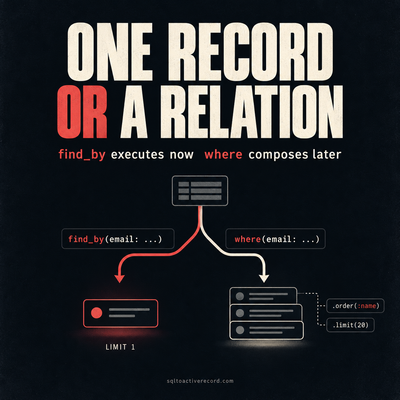
ActiveRecord where vs find_by — Which to Use When
where returns a relation, find_by returns one record or nil. Here's when each is correct, what breaks if you pick wrong, and Rails 7/8 production patterns.

ActiveRecord Ran 47 Identical Queries—Bullet Gem Found the Pattern
ActiveRecord was running 47 identical queries per request. Bullet found the pattern. Here's what caused it, how to read Bullet's output, and the fix.

Rails Counter Cache—When Posts.count Brought Down Production
posts.count hit the database on every request and brought down production. Here's how counter cache fixes it, what to watch for, and how to backfill safely.
Leave a Response
Responses (0)
No responses yet
Be the first to share your thoughts