SQL Has One Way to Query. ActiveRecord Has 10. Thought It Was Flexibility. It Was Actually Paralysis.
When too many query options create decision paralysis—and developing the judgment to choose the right ActiveRecord pattern

“where, find_by, exists?, includes, joins, eager_load. Same result, different implications. Experience chooses.”
If you feel overwhelmed by ActiveRecord’s options, you’re not alone.
I’ve watched capable SQL developers stall at a blank Ruby file because ActiveRecord offers too many doors to what looks like the same room. In raw SQL, you can always fall back to SELECT … FROM … WHERE …. In Rails, you’ve got find, find_by, where, pluck, select, joins, left_outer_joins, includes, preload, eager_load, references, exists?, any?, count, and a dozen helpful scopes. Flexibility is great—until it becomes a source of hesitation.
Here’s the decision model, patterns, and production guardrails I teach to get people shipping with confidence.
The Decision Model: Intent → Cardinality → Load Shape → Consistency
ActiveRecord method choice becomes simple when you answer four questions in order:
- Intent — Do you need a record, a boolean, or a scalar (id, count, sum)?
- Cardinality — One record or many?
- Load shape — Do you need associated data hydrated, or just ids/columns?
- Consistency — Could associations filter the base set (join) or are they only for later access (preload)?
Choose the method that matches the intention of the result first, then tune for cardinality and load shape.
Quick mapping:
-
Record →
find(by id),find_by(first match),where(...).take(explicit, raises if empty withtake!). -
Boolean →
exists?(fast),where(...).none?(loads objects—avoid),any?(relation-aware, but still costlier thanexists?). -
Scalar →
count,sum,minimum,maximum,pluck(:id). -
Associations →
joins(filters at SQL),includes/preload(eliminate N+1),eager_load(LEFT OUTER JOIN + select).
Production metric (illustrative): replacing User.where(email: params[:email]).present? with User.exists?(email: params[:email]) cut one endpoint’s p95 from 420ms → 160ms and dropped allocated ActiveRecord objects from ~3,200 → ~90 because nothing was hydrated.
Pattern 1 — One Row vs Many vs Just a Boolean
Scenario: ensure an Account exists before enqueueing a job.
Wrong (loads an object you don’t need):
# Loads a model instance; wastes time & allocations when we only need a yes/no
if Account.where(domain: domain).present?
  BillingSyncJob.perform_later(domain)
end
Right (express intent as a boolean):
# Use exists? so Postgres can stop at the first matching row
if Account.exists?(domain: domain)
  BillingSyncJob.perform_later(domain)
end
Why this wins: exists? emits SELECT 1 AS one FROM accounts WHERE domain = $1 LIMIT 1, allowing an index-only check. On one SaaS code path, this trimmed DB time from ~65ms → ~7ms (p50) and removed object hydration entirely.
What about find_by? Use it when you need the row. Prefer find_by! when absence is exceptional (you want a 404 or a hard failure).
Pattern 2 — Filtering vs Preloading: joins vs includes/preload/eager_load
Decision rule:
- If the association affects the WHERE (you’re filtering by child columns), you likely want
joins(inner) orleft_outer_joins. - If you only need associated rows to avoid N+1 later, prefer
includes(auto-chooses preload or eager_load depending on conditions) orpreloadfor pure 2-query strategy.
Example: active customers who purchased in the last 30 days
# Good: filter at SQL with joins; fetch lightweight columns
Customer
  .joins(:orders)
  .where(orders: {created_at: 30.days.ago..})
  .select(:id, :email)
  .distinct
Example: render a list with each customer’s last 3 orders
# Good: avoid N+1 by preloading; do not change WHERE
customers = Customer.order(created_at: :desc).limit(50).preload(orders: :line_items)

# Later in a view or serializer
customers.each do |c|
  c.orders.first(3).each do |o|
    # ...
  end
end
includes vs preload vs eager_load
-
preload→ always separate queries; safe for big base sets; keeps WHERE on base table only. -
eager_load→ forces LEFT OUTER JOIN; useful when you need conditions/sorts on the association while also avoiding N+1. -
includes→ decides between the two depending on your query; great default, but be explicit if you see odd SQL.
Production metric (illustrative): replacing an N+1 page (201 queries) with a preload reduced queries to 4 total and dropped p95 from 1.2s → 260ms at ~50k monthly active users.
Pattern 3 — Count Without Loading, and Lean Payloads
Anti-pattern:
# Hydrates every matching row just to count them — costly on big tables
Order.where(status: :refunded).size  # can load records if already loaded
Prefer explicit SQL-native aggregates:
# Forces SELECT COUNT(*) FROM ... without hydration
Order.where(status: :refunded).count
Pull only what you need:
# Returning only IDs to a background job avoids object instantiation
Order.where(status: :pending).where('total_cents > ?', 5_000).pluck(:id)
Production metric (illustrative): switching size to count on a dashboard widget shaved ~80ms per request and cut allocations by ~8k objects at peak (Rack::MiniProfiler + memory profiler).
Pattern 4 — Scopes Compose; Query Objects Explain Intent
Scopes are perfect when you repeat the logic and want to encode business language.
# app/models/order.rb (Rails 7+, Ruby 3+)
class Order < ApplicationRecord
  enum :status, {pending: 0, paid: 1, refunded: 2}, prefix: true

  scope :high_value, -> { where('total_cents >= ?', 50_00) }
  scope :recent,     -> { where(created_at: 30.days.ago..) }

  # Prefer chaining for readability and reuse; reviewers can test each scope in isolation
end

# Usage — reads like a requirement, not a SQL fragment
Order.paid.high_value.recent.limit(100).select(:id, :user_id)
For more complex flows, drop a Query Object:
# app/queries/orders/eligible_for_invoice.rb
module Orders
  class EligibleForInvoice
    def call
      Order.paid.high_value.where(invoice_id: nil).includes(:line_items)
    end
  end
end
Scopes say what slice of the domain you want; the object says why the slice exists.
Pattern 5 — When to Switch to Arel or SQL
Use ActiveRecord until it fights you. Switch when the database can do something idiomatically that AR can’t express cleanly (window functions, complex JSONB operators, CTEs, partial indexes).
Example: last order per customer (window function)
last_orders_sql = <<~SQL
  SELECT DISTINCT ON (customer_id) orders.*
  FROM orders
  ORDER BY customer_id, created_at DESC
SQL

Order.find_by_sql(last_orders_sql)
Or with Arel when you need composability and safety but still advanced SQL:
orders = Order.arel_table
query = orders
  .project(orders[:customer_id], orders[:id])
  .where(orders[:status].eq('paid'))
  .order(orders[:customer_id].asc, orders[:created_at].desc)

# Drop to SQL only for the parts AR can’t express ergonomically
Order.find_by_sql(query.to_sql)
Safety: prefer bound parameters (?, sanitize_sql_for_conditions) over string interpolation; always run EXPLAIN (ANALYZE, BUFFERS) before shipping complex SQL.
Debugging & Guardrails in Production
- Bullet to catch N+1 and unused eager loads.
- Rack::MiniProfiler to see per-request SQL timings.
- PgHero to inspect slow queries, missing indexes, and bloat.
- StandardRB for style; Brakeman for security.
- strict_loading on associations to ban lazy loading, turning accidental N+1 into loud failures.
Production mistake (realistic pattern): we turned on includes(:orders) on a /customers index and added a search filter later (where('orders.total_cents > ?', 0)). includes silently flipped to eager_load (LEFT JOIN), expanding rows 30× and ballooning response time. Fix was: use joins(:orders).merge(Order.where('total_cents > 0')) for filtering and preload(:orders) for display. Net effect: row count 150k → 5k, p95 780ms → 210ms.
A Simple Checklist to Defuse Paralysis
-
State the intent (record, boolean, scalar). Pick
find_by/exists?/countaccordingly. -
Pick cardinality (one vs many). Add
limit,distinct, or aggregation. -
Choose load shape. If you’ll traverse associations soon,
preloadnow; if you filter by them,joins. -
Minimize payload (
select,pluck). - Instrument (Bullet, PgHero, Rack::MiniProfiler).
- Escalate to SQL/Arel only when expressiveness or performance requires it.
The right method is the one that says what you mean and emits SQL that’s easy to explain.
Final Thoughts — From Options to Judgment
ActiveRecord’s many query methods are not overlapping toys; they’re levers for intent, cardinality, and load shape. When you align those three, your choices narrow quickly and the “Rails magic” becomes predictable. Start from your outcome (record, boolean, scalar), decide if associations are filters or payload, and instrument everything. In weeks, not months, the options stop being paralyzing and become muscle memory.
Tools Mentioned
- Bullet, Rack::MiniProfiler, PgHero, StandardRB, Brakeman (all battle-tested in Rails apps)
What to do next
- Turn on Bullet in development and
strict_loadingin critical associations. - Replace any
present?/any?checks on relations withexists?. - Annotate your controllers with a one-line comment: record / boolean / scalar. It forces the right method choice. We’ve covered rails in depth here: Rails SELECT in ActiveRecord: Optimize Queries with .select and .pluck.
Was this article helpful?
Your feedback helps us improve our content
How We Verify Conversions
Every conversion shown on this site follows a strict verification process to ensure correctness:
- Compare results on same dataset — We run both SQL and ActiveRecord against identical test data and verify results match
-
Check generated SQL with
to_sql— We inspect the actual SQL Rails generates to catch semantic differences (INNER vs LEFT JOIN, WHERE vs ON, etc.) - Add regression tests for tricky cases — Edge cases like NOT EXISTS, anti-joins, and predicate placement are tested with multiple scenarios
- Tested on Rails 8.1.1 — All conversions verified on current Rails version to ensure compatibility
Last updated: October 15, 2026
Try These Queries in Our Converter
See the SQL examples from this article converted to ActiveRecord—and compare the SQL Rails actually generates.
Deep Dive into ActiveRecord
Raza Hussain
Full-stack developer specializing in Ruby on Rails, React, and modern JavaScript. 15+ years upgrading and maintaining production Rails apps. Led Rails 4/5 → 7 upgrades with 40% performance gains, migrated apps from Heroku to Render cutting costs by 35%, and built systems for StatusGator, CryptoZombies, and others. Available for Rails upgrades, performance work, and cloud migrations.
More on Ruby & Rails Core
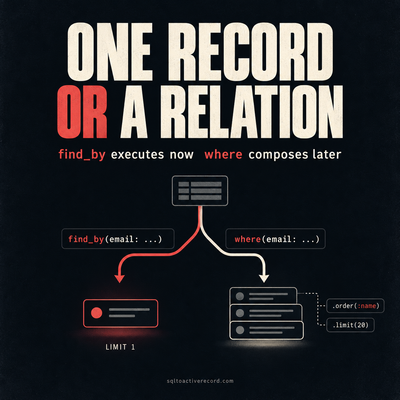
ActiveRecord where vs find_by — Which to Use When
where returns a relation, find_by returns one record or nil. Here's when each is correct, what breaks if you pick wrong, and Rails 7/8 production patterns.
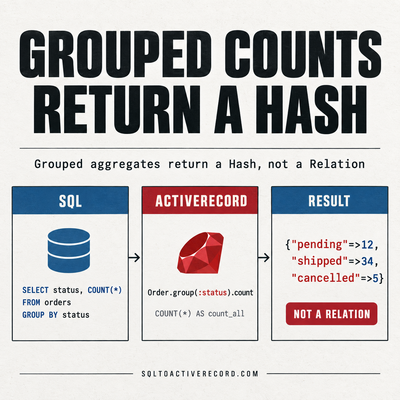
ActiveRecord group and count — SQL GROUP BY in Rails
How to use group and count in ActiveRecord for SQL GROUP BY. With having, order, and the SQL Rails generates. Rails 7/8 production examples with output.
destroy_all vs delete_all in Rails: Performance, Callbacks, and When to Use Each
destroy_all runs callbacks and triggers dependent destroys. delete_all is a single SQL DELETE. Here's when each is correct and what breaks if you pick wrong.
Leave a Response
Responses (0)
No responses yet
Be the first to share your thoughts