Why ActiveRecord Exists: The SQL Mental Model That Breaks in Rails
You’re not wrong about SQL—you’re just missing the app-level invariants Rails enforces

Start from a real production bug
You join a Rails codebase after years of writing SQL.
You open a controller and see:
Order.where(status: "open").update_all(status: "paid")Your brain says: “That’s just SQL with extra steps.”
Then a week later you’re debugging a production incident:
- orders marked “paid”
- payments not captured
- emails not sent
- accounting totals off by a day
The database is “consistent” in the SQL sense.
The application is inconsistent in the business sense.
That’s the gap ActiveRecord exists to close.
The wrong mental model
“An ORM is a query builder that hides SQL.”
If that’s all ActiveRecord was, you should delete it.
ActiveRecord’s job is not primarily to write SELECTs.
Its job is to provide an application consistency layer:
- model-level invariants (validations)
- controlled write paths (callbacks / services)
- transactions that group multiple writes
- type casting and time zone handling
- association semantics that match business rules
- predictable persistence rules across a large codebase
SQL gives you data integrity primitives.
ActiveRecord gives you a place to enforce app invariants consistently.
Why the naive “SQL everywhere” approach fails
Failure mode 1: you bypass invariants without noticing
In Rails, there are often multiple invariants tied to a write:
- setting derived fields
- enqueueing a job
- updating a counter cache
- emitting an audit log
- invalidating caches
If you do this:
UPDATE orders
SET status = 'paid'
WHERE id = 123;
You might get the row changed… and quietly skip everything else the app relies on.
In Rails, the naive equivalent is:
Order.where(id: 123).update_all(status: "paid")update_all is legitimate—but it intentionally bypasses:
- validations
- callbacks
- timestamps (unless you set them manually)
That’s not a Rails “gotcha”.
It’s a trade-off you must choose knowingly.
Failure mode 2: consistency spans multiple tables
Business events are rarely a single UPDATE.
“Mark order paid” might involve:
-
paymentsinsert -
ordersupdate -
ledger_entriesinsert -
emailsenqueue -
inventory_reservationsrelease
If you write these as independent SQL statements scattered through the app, you get:
- partial writes on exceptions
- race conditions under concurrency
- retry behavior that duplicates side effects
The correct mental model: ActiveRecord is your write contract
Think of ActiveRecord as:
- a query DSL and
- a persistence boundary and
- a consistency contract for writes
A practical example: one business event, one transaction
class CapturePayment
  def call(order_id:)
    Order.transaction do
      order = Order.lock.find(order_id)

      raise "already paid" if order.paid?

      payment = Payment.create!(
        order: order,
        amount_cents: order.total_cents,
        status: "captured"
      )

      order.update!(status: "paid", paid_at: Time.current)

      OrderMailer.paid(order.id).deliver_later

      payment
    end
  end
end
What this buys you (that “SQL everywhere” rarely does by default):
- transactional grouping (all-or-nothing)
- explicit locking (concurrency safety)
- invariants enforced in one place
- a single unit you can test and reason about
The SQL still exists—you just choose where it lives
ActiveRecord does not ban SQL. It centralizes it.
The right approach in a Rails app is:
- use AR for read + write consistency
- use SQL (via AR) when performance demands it
- keep the “contract” at the model/service boundary
Where ActiveRecord actually maps cleanly to SQL
If you’re worried AR is “magic,” anchor yourself in what it generates.
Example:
Order.where(status: "open").where("created_at < ?", 30.days.ago)Typical generated SQL:
SELECT "orders".*
FROM "orders"
WHERE "orders"."status" = 'open'
  AND (created_at < '2025-12-07 00:00:00');
The ORM isn’t the enemy.
Unverified assumptions about what it generates are.
The performance trap: “ActiveRecord is slow”
The real statement is:
“Allocating thousands of objects and doing N+1 queries is slow.”
ActiveRecord makes it easy to accidentally do both.
The naive version (N+1)
orders = Order.where(status: "open").limit(100)
orders.each { |o| o.user.email }
The correct version (preload)
orders = Order.where(status: "open").includes(:user).limit(100)
orders.each { |o| o.user.email }
ActiveRecord didn’t create the performance issue.
The mental model did: “loops are free” and “queries are cheap.”
Edge cases & production pitfalls
1) update_all / delete_all are sharp knives
Use them when you truly want to bypass callbacks/validations. Document why, and consider writing an explicit “maintenance” service so it’s not repeated casually.
2) Callbacks can become invisible coupling
Callbacks are useful for invariants, but they can hide side effects. If a callback triggers network calls or heavy work, move it to a service or background job.
3) Validations are not database constraints
Validations prevent bad writes through Rails. They do not protect you from:
- direct SQL
- other services
- concurrent writes
Use DB constraints for true integrity (NOT NULL, FK, unique indexes), and AR validations for user-facing/business rules.
4) Transactions don’t cover external side effects
Emails, HTTP calls, and message publishes aren’t rolled back by DB transactions.
Prefer outbox patterns or after_commit hooks for side effects that must reflect committed state.
Rule of thumb
Use SQL to express data. Use ActiveRecord to express business events.
If you’re doing a write that has meaning in the product, don’t scatter raw SQL. Put it behind an ActiveRecord-backed contract: transactions, invariants, and explicit side effects.
That’s the “click.”
Was this article helpful?
Your feedback helps us improve our content
How We Verify Conversions
Every conversion shown on this site follows a strict verification process to ensure correctness:
- Compare results on same dataset — We run both SQL and ActiveRecord against identical test data and verify results match
-
Check generated SQL with
to_sql— We inspect the actual SQL Rails generates to catch semantic differences (INNER vs LEFT JOIN, WHERE vs ON, etc.) - Add regression tests for tricky cases — Edge cases like NOT EXISTS, anti-joins, and predicate placement are tested with multiple scenarios
- Tested on Rails 8.1.1 — All conversions verified on current Rails version to ensure compatibility
Last updated: October 14, 2026
Try These Queries in Our Converter
See the SQL examples from this article converted to ActiveRecord—and compare the SQL Rails actually generates.
Deep Dive into ActiveRecord
Raza Hussain
Full-stack developer specializing in Ruby on Rails, React, and modern JavaScript. 15+ years upgrading and maintaining production Rails apps. Led Rails 4/5 → 7 upgrades with 40% performance gains, migrated apps from Heroku to Render cutting costs by 35%, and built systems for StatusGator, CryptoZombies, and others. Available for Rails upgrades, performance work, and cloud migrations.
More on Ruby & Rails Core
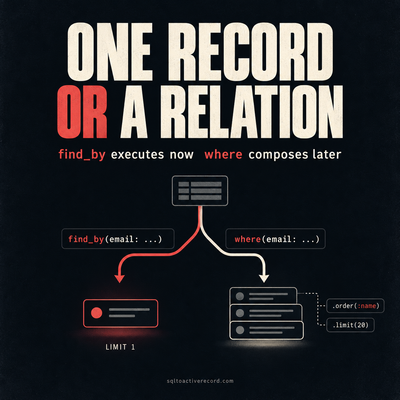
ActiveRecord where vs find_by — Which to Use When
where returns a relation, find_by returns one record or nil. Here's when each is correct, what breaks if you pick wrong, and Rails 7/8 production patterns.

ActiveRecord Ran 47 Identical Queries—Bullet Gem Found the Pattern
ActiveRecord was running 47 identical queries per request. Bullet found the pattern. Here's what caused it, how to read Bullet's output, and the fix.

Rails Counter Cache—When Posts.count Brought Down Production
posts.count hit the database on every request and brought down production. Here's how counter cache fixes it, what to watch for, and how to backfill safely.
Leave a Response
Responses (0)
No responses yet
Be the first to share your thoughts