ActiveRecord find_by Returns nil: Rails Reference 2026
find_by returns nil, find raises RecordNotFound. Nil handling, rescue patterns, and when to use each in production Rails apps.
Quick Answer
Yes, ActiveRecord’s find_by returns nil if no record is found. This is different from find, which raises ActiveRecord::RecordNotFound.
# Returns nil if not found
user = User.find_by(email: 'missing@example.com')
# => nil

# Raises exception if not found
user = User.find(999999)
# => ActiveRecord::RecordNotFound
When find_by Returns nil
The find_by method returns nil in these situations:
- No record matches the given conditions
- The table is empty
- The attribute value doesn’t exist in any record
find vs find_by Comparison
| Method | Search By | Not Found Behavior | Use Case |
|---|---|---|---|
find |
Primary key (id) | Raises exception | When record MUST exist |
find_by |
Any attribute(s) | Returns nil | When record might not exist |
Safe nil Handling Patterns
1. Safe Navigation Operator
user = User.find_by(email: params[:email])
user&.update(last_login: Time.current)
2. Presence Check
if user = User.find_by(email: params[:email])
  user.send_welcome_email
else
  flash[:error] = "User not found"
end
3. find_or_create_by
user = User.find_or_create_by(email: params[:email]) do |u|
  u.name = params[:name]
end
4. find_or_initialize_by
user = User.find_or_initialize_by(email: params[:email])
user.new_record? # => true if not found
5. Default Value with ||
user = User.find_by(email: params[:email]) || User.newProduction Best Practices
- Always handle nil: Never assume find_by will return a record
- Use find for IDs: When searching by ID and record must exist
- Use find_by for attributes: When searching by email, username, etc.
- Log unexpected nils: Track when expected records aren’t found We’ve covered SQL to ActiveRecord in depth here: ActiveRecord to Raw SQL—When ORM Costs 80% Performance in Production.
Common Mistakes
❌ Don’t do this:
user = User.find_by(email: params[:email])
user.name # NoMethodError if nil!
✅ Do this instead:
user = User.find_by(email: params[:email])
user&.name || "Guest"
Related Methods
-
find: Search by ID, raises if not found -
find_by!: Like find_by but raises if not found -
where(...).first: Similar to find_by but less efficient -
exists?: Check if record exists without loading it
Summary
-
find_byalways returns nil when no record matches - Use safe navigation (
&.) or presence checks to handle nil - Choose
findwhen record must exist,find_bywhen it might not - Never call methods on find_by results without nil checking For more on Ruby & Rails Core, read ActiveRecord Ran 47 Identical Queries—Bullet Gem Found the Pattern.
Frequently asked questions
- Does ActiveRecord find_by return nil if no record is found?
- Yes, ActiveRecord's find_by method returns nil when no record matches the given conditions. This is different from find, which raises an ActiveRecord::RecordNotFound exception.
- What's the difference between find and find_by?
- find searches by primary key (id) and raises exception if not found. find_by searches by any attribute and returns nil if not found. Use find when record must exist, find_by when it might not.
- How do I safely handle nil from find_by?
- Use safe navigation (&.), presence checks (if user = User.find_by(...)), find_or_create_by, find_or_initialize_by, or || operator for default values.
- When should I use find_by instead of where.first?
- Always prefer find_by - it's more concise, clearer in intent, and generates efficient SQL with LIMIT 1. Use where.first only when additional query chaining is needed.
Was this article helpful?
Your feedback helps us improve our content
How We Verify Conversions
Every conversion shown on this site follows a strict verification process to ensure correctness:
- Compare results on same dataset — We run both SQL and ActiveRecord against identical test data and verify results match
-
Check generated SQL with
to_sql— We inspect the actual SQL Rails generates to catch semantic differences (INNER vs LEFT JOIN, WHERE vs ON, etc.) - Add regression tests for tricky cases — Edge cases like NOT EXISTS, anti-joins, and predicate placement are tested with multiple scenarios
- Tested on Rails 8.1.1 — All conversions verified on current Rails version to ensure compatibility
Last updated: November 29, 2026
Try These Queries in Our Converter
See the SQL examples from this article converted to ActiveRecord—and compare the SQL Rails actually generates.
Deep Dive into ActiveRecord
Raza Hussain
Full-stack developer specializing in Ruby on Rails, React, and modern JavaScript. 15+ years upgrading and maintaining production Rails apps. Led Rails 4/5 → 7 upgrades with 40% performance gains, migrated apps from Heroku to Render cutting costs by 35%, and built systems for StatusGator, CryptoZombies, and others. Available for Rails upgrades, performance work, and cloud migrations.

date_trunc and Group by Month in ActiveRecord
Group by month in ActiveRecord with PostgreSQL date_trunc. Tested time zone handling, key types, missing months, and what groupdate adds.
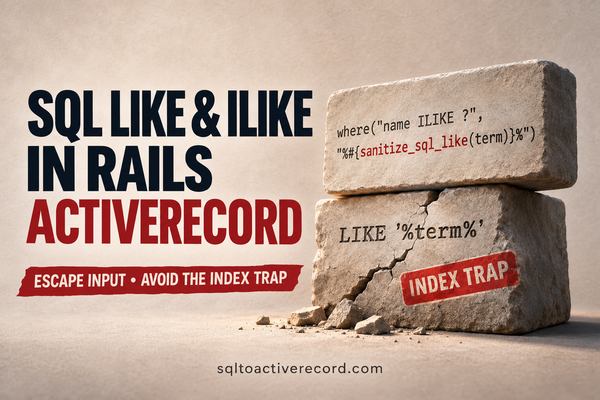
SQL LIKE and ILIKE in Rails ActiveRecord
Write LIKE and ILIKE in ActiveRecord, escape input with sanitize_sql_like, and see which patterns use an index. Tested on Rails 8.1 and PostgreSQL 16.
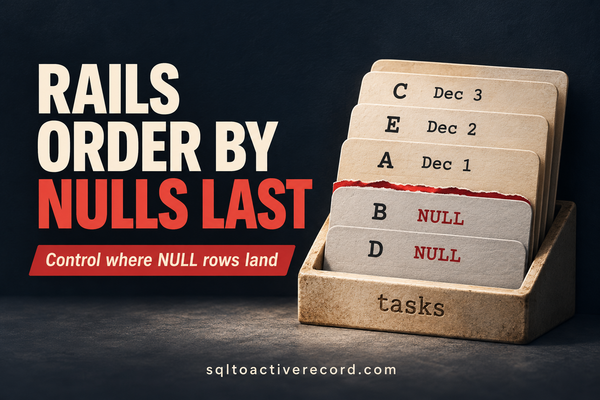
Rails ORDER BY NULLS LAST in ActiveRecord
Sort NULLs last in Rails: Arel nulls_last, the raw string trap on SQLite, an IS NULL fallback and the PostgreSQL index. Tested on Rails 8.1.1.
Leave a Response
Responses (0)
No responses yet
Be the first to share your thoughts