ActiveRecord Equivalent of SQL CROSS JOIN (And When You Actually Need It)
Rails has no first-class cross_join—so you either generate rows, join a derived table, or you’re about to build a Cartesian explosion

TL;DR: ActiveRecord has no cross_joins method. Use from("table1, table2") or a raw string join. CROSS JOINs are rarely what you want — they produce every combination of rows. The legitimate use cases are: generating combinations from a small dimension table, or building test fixtures. Always add a LIMIT or WHERE; never CROSS JOIN large tables. For more on activerecord, read 7 Production-Safe Ways to Do a SQL CROSS JOIN in Rails (and When You Actually Should).
Start from a real production bug
Someone “optimizes” a report query and ships this:
Order.joins("CROSS JOIN users")It works in staging.
In production it pins the database: millions of rows multiplied into billions, disk spills start, and your app times out.
CROSS JOIN wasn’t the clever part.
Knowing when you can afford a Cartesian product was.
The wrong mental model
“CROSS JOIN is just another kind of JOIN.”
No. CROSS JOIN is multiplication.
If table A has 10,000 rows and table B has 10,000 rows, a CROSS JOIN produces 100,000,000 rows before you filter anything.
So the first question is never “how do I write it in ActiveRecord?”
It’s:
“Do I really want A×B, or do I want a normal join / EXISTS / grouping?”
When a CROSS JOIN is actually the right tool
CROSS JOIN is usually correct when you’re joining to a small derived set:
- a generated series of dates
- a small set of constants
- a handful of “buckets” you want to report against
- a single-row derived table (basically safe)
Typical SQL example (Postgres):
SELECT day::date, COUNT(*)
FROM generate_series(current_date - 6, current_date, interval '1 day') day
CROSS JOIN orders
WHERE orders.created_at >= day
  AND orders.created_at < day + interval '1 day'
GROUP BY day
ORDER BY day;
Here, the “cartesian” side is only 7 rows. That’s safe.
Why the naive ActiveRecord approach fails
Naive: raw CROSS JOIN string
Order.joins("CROSS JOIN users")This has three production problems:
- It’s extremely easy to accidentally join a large table.
- It encourages bolting conditions on later, after the explosion already happened.
- It often leads to string-built SQL, which makes bind parameters and refactors harder.
The correct approaches in Rails
Rails doesn’t have a dedicated cross_joins API in ActiveRecord (as of Rails 8.1),
so you pick one of these patterns depending on what you’re cross joining.
Pattern 1: CROSS JOIN a small derived set (recommended)
Example: join a small list of “states” or “buckets”
You can CROSS JOIN a VALUES (...) table.
buckets_sql = <<~SQL.squish
  (VALUES ('new'), ('processing'), ('paid')) AS buckets(status)
SQL

rows = Order
  .from("orders CROSS JOIN #{buckets_sql}")
  .where("orders.status = buckets.status")
  .group("buckets.status")
  .count
Typical SQL shape:
SELECT buckets.status, COUNT(*)
FROM orders
CROSS JOIN (VALUES ('new'), ('processing'), ('paid')) AS buckets(status)
WHERE orders.status = buckets.status
GROUP BY buckets.status
Pattern 2: CROSS JOIN with a generated series (reporting)
If you’re on Postgres, generate_series is often the real goal.
days = <<~SQL.squish
  generate_series(current_date - 6, current_date, interval '1 day') AS day
SQL

relation = Order
  .from("orders CROSS JOIN #{days}")
  .where("orders.created_at >= day AND orders.created_at < day + interval '1 day'")
  .group("day")
  .order("day")
  .select("day::date AS day, COUNT(*) AS orders_count")
This is one of the few scenarios where CROSS JOIN is the cleanest tool.
Pattern 3: CROSS JOIN two real tables (rare, but possible)
If you genuinely need A×B (and B is small), do it explicitly:
relation = Order
  .joins("CROSS JOIN users")
  .where("users.id = ?", user_id)
  .select("orders.id, users.email")
What matters is that one side is bounded.
orders × 1 user is safe; orders × all users is not.
Production pitfalls & edge cases
1) WHERE conditions don’t save you if the explosion is huge
The planner may still build massive intermediate results. Always estimate row counts.
2) CROSS JOIN is not eager loading
This is SQL shaping, not association loading. If you’re doing it to “avoid N+1”, you’re probably solving the wrong problem.
3) Memory and spill risk
CROSS JOIN often forces sorts/hashes over huge row sets. Watch for:
- work_mem spills
- temp file growth
- timeouts under concurrency
4) Prefer EXISTS for “does a match exist?”
A lot of “cross join then filter” intent is better expressed as EXISTS.
Rule of thumb
If you’re CROSS JOINing two real tables, you’re probably shipping a time bomb.
Use CROSS JOIN when one side is:
- a tiny derived set (VALUES)
- a generated series (dates/buckets)
- a single-row helper
Otherwise, reach for:
- a normal join with an ON condition
- EXISTS
- aggregation with grouping
- precomputed tables/materialized views for reports
Was this article helpful?
Your feedback helps us improve our content
How We Verify Conversions
Every conversion shown on this site follows a strict verification process to ensure correctness:
- Compare results on same dataset — We run both SQL and ActiveRecord against identical test data and verify results match
-
Check generated SQL with
to_sql— We inspect the actual SQL Rails generates to catch semantic differences (INNER vs LEFT JOIN, WHERE vs ON, etc.) - Add regression tests for tricky cases — Edge cases like NOT EXISTS, anti-joins, and predicate placement are tested with multiple scenarios
- Tested on Rails 8.1.1 — All conversions verified on current Rails version to ensure compatibility
Last updated: October 15, 2026
Try These Queries in Our Converter
See the SQL examples from this article converted to ActiveRecord—and compare the SQL Rails actually generates.
Deep Dive into ActiveRecord
Raza Hussain
Full-stack developer specializing in Ruby on Rails, React, and modern JavaScript. 15+ years upgrading and maintaining production Rails apps. Led Rails 4/5 → 7 upgrades with 40% performance gains, migrated apps from Heroku to Render cutting costs by 35%, and built systems for StatusGator, CryptoZombies, and others. Available for Rails upgrades, performance work, and cloud migrations.
More on Joins & Associations
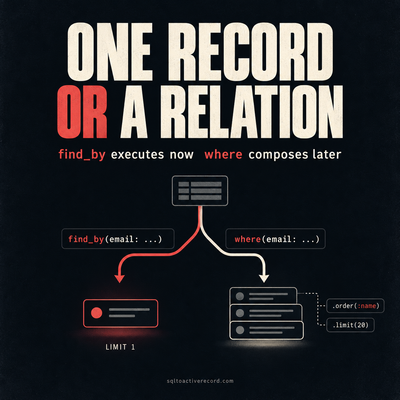
ActiveRecord where vs find_by — Which to Use When
where returns a relation, find_by returns one record or nil. Here's when each is correct, what breaks if you pick wrong, and Rails 7/8 production patterns.

5-Table ActiveRecord Join: 8s → 200ms With Subquery Rewrite
A 5-table ActiveRecord join took 8 seconds. Rewriting it as a subquery took it to 200ms. Here's what changed and why the query planner behaves differently.

Rails Counter Cache—When Posts.count Brought Down Production
posts.count hit the database on every request and brought down production. Here's how counter cache fixes it, what to watch for, and how to backfill safely.
Leave a Response
Responses (0)
No responses yet
Be the first to share your thoughts