Rails WHERE Clause in ActiveRecord: Conditions, Multiple Clauses, and OR Logic
Master Rails WHERE queries with multiple conditions, OR logic, and SQL strings. Learn when to use WHERE vs HAVING and how to verify your generated SQL.

Rails WHERE Clause in ActiveRecord: Conditions, Multiple Clauses, and OR Logic
Your Rails queries look fine in code review, but production tells a different story. Filters stack up, edge cases sneak in, and suddenly a simple where returns the wrong records—or worse, scans the whole table. I’ve shipped enough Rails apps to know this pain usually comes from misunderstanding how ActiveRecord builds SQL. Here’s how to write precise WHERE clauses with multiple conditions, OR logic, and raw SQL—plus how to verify what Rails actually sends to the database.
Hash Conditions: The Rails Way (Until It Isn’t)
Most Rails queries start with hash conditions because they’re readable and safe. They parameterize values for you and map cleanly to equality checks.
# Find active accounts on a paid plan
accounts = Account.where(status: :active, plan: :paid)

accounts.pluck(:id)
# => [12, 19, 42]
This translates to a simple AND under the hood. Rails merges hash keys into one WHERE clause, which is usually what you want. It’s fast, indexed, and hard to mess up.
But hashes hit a wall quickly. You can’t express ranges, partial matches, or database functions cleanly. That’s when people start stacking where calls without realizing what Rails is doing.
# These are combined with AND
Account.where(status: :active)
       .where("created_at > ?", 30.days.ago)
That’s fine. Rails merges them into a single WHERE clause.
Pro tip: Multiple
wherecalls don’t generate subqueries. Rails collapses them into one SQL WHERE, so readability is the main reason to chain them.
String Conditions and Placeholders (Do This Safely)
The moment you need comparisons, LIKE, or database-specific operators, you’ll reach for string conditions. That’s fine—just don’t interpolate values.
# Find users by email domain
users = User.where("email ILIKE ?", "%@example.com")

users.count
# => 87
Placeholders keep you safe from SQL injection and let the adapter handle quoting. This matters more than people admit—I’ve seen string interpolation slip into production code during a hotfix.
Named placeholders improve readability when conditions grow.
User.where(
  "last_sign_in_at < :cutoff AND failed_attempts > :attempts",
  cutoff: 14.days.ago,
  attempts: 3
)
This is still one WHERE clause. Rails isn’t doing anything fancy—it’s just binding values.
Watch out: If you interpolate strings, you bypass ActiveRecord’s sanitization. One bad param can turn into a security incident.
Multiple Conditions vs OR Logic (The Gotcha)
Here’s where most bugs happen. Developers expect or to behave like chaining where, but it doesn’t.
# ❌ This is NOT what you think
User.where(role: :admin).or(User.where(active: true))
This generates an OR at the SQL level. That means you’ll get all active users, not just active admins. I’ve seen this leak data into admin dashboards.
If you need grouped logic, be explicit.
# Admins who are active OR recently signed in
users = User.where(role: :admin)
            .where(
              "active = :active OR last_sign_in_at > :recent",
              active: true,
              recent: 7.days.ago
            )
Now the intent is clear, and Rails generates a single WHERE with parentheses where needed.
You can also use Arel for complex cases, but I only reach for it when string SQL gets unreadable.
Real talk:
orreads nicely but hides SQL complexity. I avoid it unless I’ve inspected the generated query.
WHERE vs HAVING: Filtering Rows vs Groups
This one bites experienced developers too. WHERE filters rows before grouping. HAVING filters after aggregation.
Imagine you want users with more than one active subscription.
users = User.joins(:subscriptions)
            .where(subscriptions: { status: :active })
            .group("users.id")
            .having("COUNT(subscriptions.id) > 1")
Generated SQL:
SELECT users.* FROM users
INNER JOIN subscriptions ON subscriptions.user_id = users.id
WHERE subscriptions.status = 'active'
GROUP BY users.id
HAVING COUNT(subscriptions.id) > 1
If you put that count condition in where, PostgreSQL will error—or worse, MySQL will do something surprising.
Performance note: Push as much filtering as possible into
WHERE.HAVINGruns after grouping and can’t use indexes the same way.
Verifying the Generated SQL (Always Do This)
If you’re not checking the SQL, you’re guessing. Rails gives you multiple ways to inspect queries.
relation = Account.where(status: :active).where("balance_cents > 0")

relation.to_sql
# => "SELECT \"accounts\".* FROM \"accounts\" WHERE \"accounts\".\"status\" = 'active' AND (balance_cents > 0)"
In development, enable verbose query logs.
# config/environments/development.rb
config.active_record.verbose_query_logs = true
This shows where queries originate, which saved me hours tracking down a bad or chain in a controller.
You can also copy-paste SQL into your database console and run EXPLAIN ANALYZE. That’s where you’ll catch missing indexes.
Pro tip: If a column appears in a WHERE clause on hot paths, it needs an index. I’ve seen single missing indexes slow queries by 50x.
Common Production Mistakes I’ve Made
I once combined or with includes and assumed Rails would “do the right thing.” It didn’t. The query returned duplicate rows and blew up pagination counts.
Another time, I used string conditions for convenience and forgot placeholders during a rush. We caught it in review—but barely.
The lesson is boring but effective: keep WHERE clauses explicit, inspect the SQL, and favor clarity over cleverness.
Final Thoughts
Use hash conditions for simple equality filters and chain them freely—they’re safe and readable. Switch to string conditions or HAVING when the data shape demands it, but always verify the SQL. If a query matters in production, inspect it, index it, and test it under real data.
Was this article helpful?
Your feedback helps us improve our content
How We Verify Conversions
Every conversion shown on this site follows a strict verification process to ensure correctness:
- Compare results on same dataset — We run both SQL and ActiveRecord against identical test data and verify results match
-
Check generated SQL with
to_sql— We inspect the actual SQL Rails generates to catch semantic differences (INNER vs LEFT JOIN, WHERE vs ON, etc.) - Add regression tests for tricky cases — Edge cases like NOT EXISTS, anti-joins, and predicate placement are tested with multiple scenarios
- Tested on Rails 8.1.1 — All conversions verified on current Rails version to ensure compatibility
Last updated: October 15, 2026
Try These Queries in Our Converter
See the SQL examples from this article converted to ActiveRecord—and compare the SQL Rails actually generates.
Deep Dive into ActiveRecord
Raza Hussain
Full-stack developer specializing in Ruby on Rails, React, and modern JavaScript. 15+ years upgrading and maintaining production Rails apps. Led Rails 4/5 → 7 upgrades with 40% performance gains, migrated apps from Heroku to Render cutting costs by 35%, and built systems for StatusGator, CryptoZombies, and others. Available for Rails upgrades, performance work, and cloud migrations.
More on SQL to ActiveRecord

Database Indexes Existed. ActiveRecord Ignored Them.
The database had indexes. ActiveRecord queries weren't using them. Here's how ActiveRecord query patterns bypass indexes and how to check EXPLAIN output.
ActiveRecord where vs find_by — Which to Use When
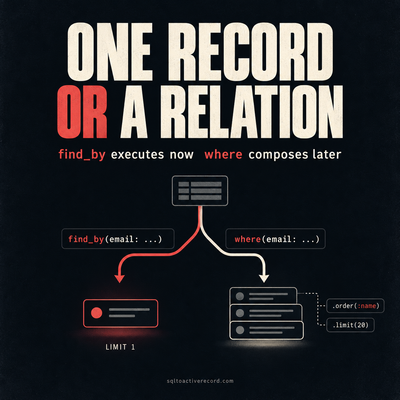
where returns a relation, find_by returns one record or nil. Here's when each is correct, what breaks if you pick wrong, and Rails 7/8 production patterns.
ActiveRecord group and count — SQL GROUP BY in Rails
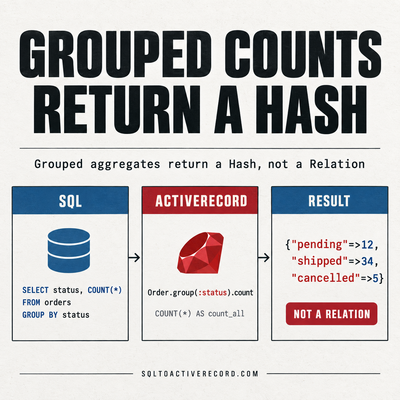
How to use group and count in ActiveRecord for SQL GROUP BY. With having, order, and the SQL Rails generates. Rails 7/8 production examples with output.
Leave a Response
Responses (0)
No responses yet
Be the first to share your thoughts