Upgrading to Rails 8.2 Without Downtime
A Production Migration Playbook for Rails 8.2 and Ruby 4.0

Rails upgrades fail for boring reasons.
Not because Rails 8.2 is unstable. Not because Ruby 4.0 is risky. They fail because production systems have state, traffic, and timing — and most upgrade guides pretend those don’t exist.
If you run a real Rails app, upgrading to Rails 8.2 requires planning, sequencing, and rollback paths. Let’s walk through what actually works in production.
The Wrong Mental Model: “If Tests Pass, We’re Safe”
Tests validate correctness. They don’t validate behavior under load.
Rails 8.2 introduces new defaults, stricter Active Record behavior, and subtle concurrency changes. Ruby 4.0 removes execution slack. Together, they surface problems tests never catch.
If your upgrade plan is “bundle update rails and deploy,” you’re gambling.
Production failures happen at integration boundaries — not in unit tests.
Audit Rails 8.2 Defaults Before You Enable Them
Rails 8.2 ships with defaults that change runtime behavior:
- Transaction boundaries
- Association loading semantics
- Concurrency assumptions
Don’t enable them blindly.
# config/application.rb
config.load_defaults 7.2
Upgrade Rails first. Opt into 8.2 defaults later, one by one.
This lets you isolate regressions instead of debugging everything at once.
Migrations Are the Most Dangerous Part
Schema changes cause more downtime than code.
Rails 8.2 migration helpers make it easy to do the wrong thing safely — like locking a table during peak traffic.
Avoid this pattern:
add_column :users, :status, :string, default: "active"Instead:
add_column :users, :status, :string
# backfill in batches
# add default later
Ruby 4.0 won’t save you from database locks.
Staged Rollouts Beat Big Bang Deploys
What works:
- Dual-boot Rails versions
- Feature-flag framework behavior
- Canary deploys
Ship Rails 8.2 code paths dark. Enable them gradually. Measure P95 and P99, not averages.
If you can’t roll back in minutes, you’re not ready to deploy.
Final Thoughts
Rails 8.2 and Ruby 4.0 are production-ready. Your upgrade process might not be.
Treat upgrades as operational changes, not code changes. When you do, Rails 8.2 is predictable, boring, and safe — exactly what you want in production. To solve rails, see Ruby 3.5 Preview: What Matters for Rails in Production.
Was this article helpful?
Your feedback helps us improve our content
How We Verify Conversions
Every conversion shown on this site follows a strict verification process to ensure correctness:
- Compare results on same dataset — We run both SQL and ActiveRecord against identical test data and verify results match
-
Check generated SQL with
to_sql— We inspect the actual SQL Rails generates to catch semantic differences (INNER vs LEFT JOIN, WHERE vs ON, etc.) - Add regression tests for tricky cases — Edge cases like NOT EXISTS, anti-joins, and predicate placement are tested with multiple scenarios
- Tested on Rails 8.1.1 — All conversions verified on current Rails version to ensure compatibility
Last updated: October 15, 2026
Try These Queries in Our Converter
See the SQL examples from this article converted to ActiveRecord—and compare the SQL Rails actually generates.
Deep Dive into ActiveRecord
Raza Hussain
Full-stack developer specializing in Ruby on Rails, React, and modern JavaScript. 15+ years upgrading and maintaining production Rails apps. Led Rails 4/5 → 7 upgrades with 40% performance gains, migrated apps from Heroku to Render cutting costs by 35%, and built systems for StatusGator, CryptoZombies, and others. Available for Rails upgrades, performance work, and cloud migrations.
More on Ruby & Rails Core
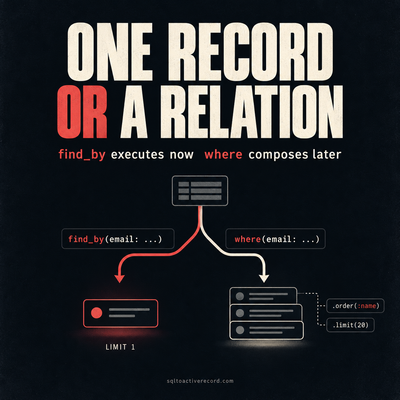
ActiveRecord where vs find_by — Which to Use When
where returns a relation, find_by returns one record or nil. Here's when each is correct, what breaks if you pick wrong, and Rails 7/8 production patterns.
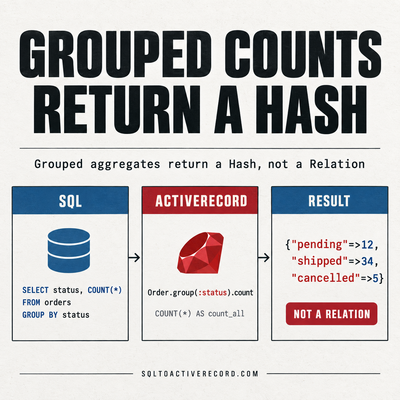
ActiveRecord group and count — SQL GROUP BY in Rails
How to use group and count in ActiveRecord for SQL GROUP BY. With having, order, and the SQL Rails generates. Rails 7/8 production examples with output.
destroy_all vs delete_all in Rails: Performance, Callbacks, and When to Use Each
destroy_all runs callbacks and triggers dependent destroys. delete_all is a single SQL DELETE. Here's when each is correct and what breaks if you pick wrong.
Leave a Response
Responses (0)
No responses yet
Be the first to share your thoughts